Get Full Government Meeting Transcripts, Videos, & Alerts Forever!
Get email alerts on the Police Station Financing topic
No spam. Unsubscribe anytime.
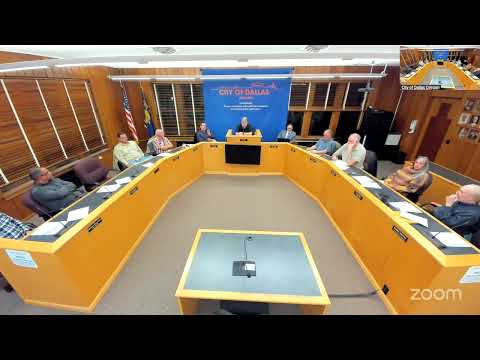
Dallas council weighs revenue bond, new fee to revive police station after failed May ballot measure
Summary
At a Nov. 17 work session, council members reviewed value-engineering progress and compared a traditional general-obligation bond (property-tax funded) to a revenue bond paid by a fixed police-station fee; staff set Dec. 15 for final cost estimates and noted Feb. 26 is the latest date to decide to place a measure on the May 19, 2026 ballot.
At a Nov. 17 Dallas City Council work session, staff outlined options to revive a police station project after a bond measure failed in May and recommended considering a revenue bond paid by a fixed police-station fee rather than a property-tax general-obligation bond.
An unidentified presenter (Speaker 4) told the council the value-engineering exercise on the prior proposal is nearly complete and scheduled a Dec. 15 work session where architects and the contractor will present final numbers. "We had a bond election this last May. The bond measure failed," Speaker 4 said, adding the value-engineering work should be wrapped up in the next couple of weeks.
Speaker 4 presented two debt scenarios to the council: Debt Plan A (the previously proposed general-obligation bond) used a $17.2 million project fund, a 30-year term and an estimated total debt of about $37.5 million; Debt Plan B (a revenue bond) used a hypothetical $14 million project fund, a 20-year term and an estimated total debt a little over $23 million. Under the revenue-bond model, the revenue source "would be a police station fee that would be collected through the city bill," Speaker 4 said, producing a fixed monthly charge for each sewer account rather than a variable, property-value-based payment.
Council members asked how the hypothetical numbers were derived. Speaker 4 said the $14 million figure was an adviser-run scenario to illustrate comparative debt outcomes; final project costs will depend on the Dec. 15 value-engineering results. Speaker 4 also noted the city applied for a $500,000 green infrastructure grant through the Department of Land Conservation Development and expected to learn results in January; any grant award would reduce the project fund required.
The council discussed timing and ballot logistics. Speaker 4 said the deadline to file a ballot measure with Polk County is Feb. 27 (the staff presentation noted Feb. 26 as the practical last day to decide so paperwork can be filed the next day). The council identified existing meeting dates in December, January and February to review and approve any referral; Speaker 4 warned that once a measure is referred, city staff may no longer work on campaign activities and any outreach would likely be done by elected officials or an outside political-action committee.
On public sellability, some council members and commenters said a $15–$17 million ask was unlikely to pass without clearer messaging and a different financing structure. "There's no way I think we can sell it," said Speaker 5, describing recent voter sentiment. Several council members argued the central public message must emphasize that "this isn't the same proposal" and explain how a revenue-bond structure reduces long-term debt and spreads costs more broadly.
Council members also explored alternatives. Converting or renovating the Polk County Itemizer building was raised as a lower-cost option but staff said achieving a $10–$11 million project would require eliminating programming or building something significantly smaller; renovating might yield long-term redevelopment opportunities if the city later builds a new station and vacates downtown property.
Operational details and price points were discussed in ballpark terms: staff said current public-safety fees used in modeling were roughly $12.50–$12.83 per account with estimates that a revenue-bond-supported fee for a $14–$16 million project would likely land in the $14–$15 per month range, depending on final project costs and conservative growth projections. The city estimated roughly 7,200 sewer accounts would share the fee, and growth in accounts could either shorten the debt term or reduce the annual fee collected.
No formal motion or vote occurred during the work session. Several members expressed support for returning a question to voters under a revenue-bond model, and Speaker 1 stated, "I am 100% behind putting this back on the ballot again with a ... police station fee." The council directed staff to finalize the value-engineering report for the Dec. 15 presentation, expect a grant decision in January, and keep Feb. 26–27 as the drop-dead window to file for the May 19, 2026 ballot if the council opts to refer a measure.
The council adjourned the work session until 7 p.m.