
Jupiter council approves first-reading land-use and zoning changes for Beacon Park parcel; asks staff for trip-cap and traffic analysis
Get AI-powered insights, summaries, and transcripts
Subscribe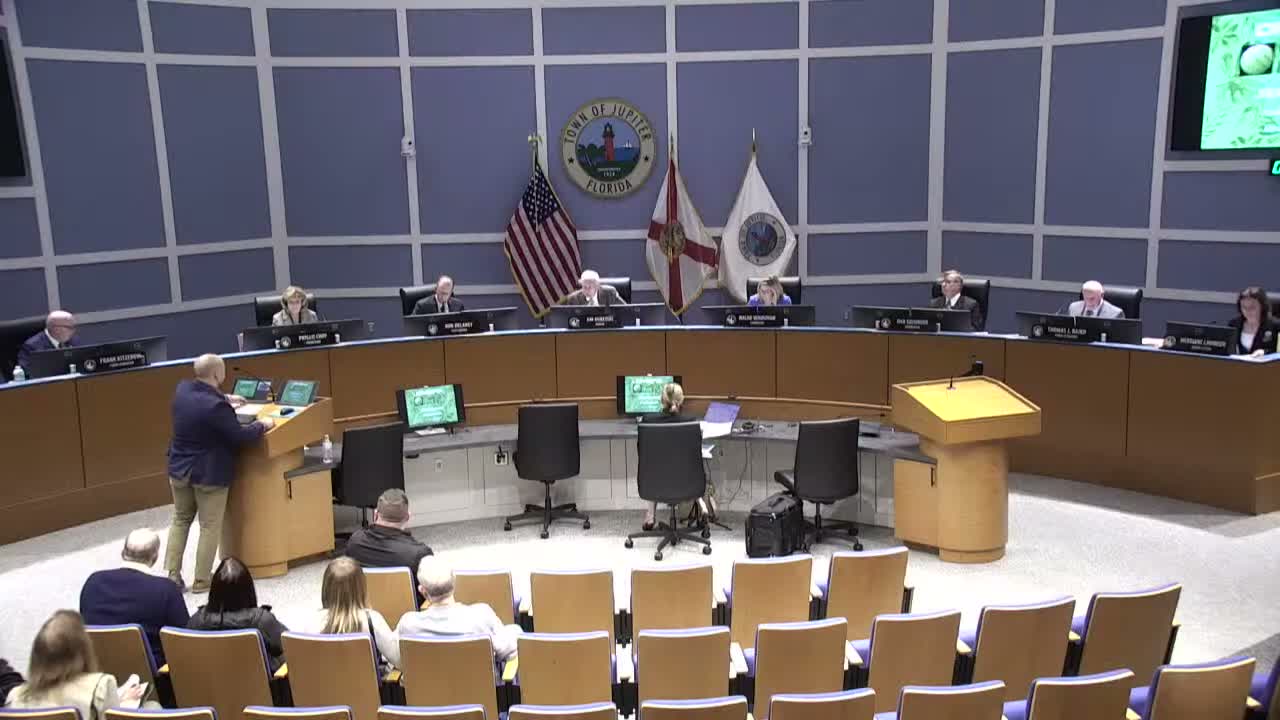
Summary
On Jan. 20 the Jupiter Town Council approved on first reading a future land-use amendment and a zoning map change for the east portion of the 57-acre Beacon Park parcel, citing a projected large reduction in traffic. Council directed staff to draft trip-cap language and return with additional traffic and workforce-housing analysis for the west side.
The Jupiter Town Council on Tuesday approved, on first reading, ordinances to change the future land-use designation and zoning for roughly 34.3 acres on the east side of the 57-acre Beacon Park parcel, moving the area to low-density single-family residential and R‑1 zoning.
The action followed a presentation from Zach Sasser, agent for Pulte Divosta and the Simon family, who urged the council that "the residential mitigates traffic impact to Indiantown Road" and said the applicant’s modeling showed industrial entitlements would produce about four cars per minute during peak hour while the proposed residential land use would equate to about one car per minute — an 80% reduction "just from the land use alone." Sasser said the applicant has submitted a separate site plan proposing 99 units but emphasized tonight’s vote concerned only the land-use and zoning changes.
The vote advances Ordinance 2‑26 (future land-use amendment) and Ordinance 7‑26 (zoning map amendment) after a broader discussion on whether to preserve industrial land in town. Planning-and-zoning staff and the commission recommended residential for the east side and suggested imposing a trip cap to limit development potential and match the applicant’s proposed build-out. Garrett Watson of Planning & Zoning told councilors the commission preferred R‑1 (standard single-family) rather than the applicant’s requested compact R‑1A, citing consistency with surrounding lot sizes and a two‑story height limit.
Council members cited competing priorities: reducing traffic on Indiantown Road and offering some workforce housing versus retaining industrial acreage to support economic diversity. Councilor Sundstrom and others noted Jupiter already has a high proportion of residential land and asked staff for data on how much industrial land could be lost if multiple pending applications proceed.
Mayor Kuretsky signaled support for the east-side conversion and said he would be "supportive of directing staff to include the trip cap, to limit development potential of the property." Multiple council members asked staff to return with traffic modeling that compares split east/west scenarios and the feasibility of meeting the town’s workforce-housing requirement (12% on-site when a land-use change is approved).
Votes on related consent items earlier in the meeting also included first-reading approval of Ordinances 4‑26, 5‑26 and 6‑26 (annexation, a small-scale future land-use amendment and a zoning amendment for other parcels), each carried by voice vote with no recorded opposition.
Next steps: council approved the east-side ordinances on first reading and directed staff to draft trip-cap language and to provide traffic and workforce-housing analyses for the west side. The ordinances will return for second reading with any trip-cap amendments and with site-plan materials when staff and the applicant have synchronized documents.