Get Full Government Meeting Transcripts, Videos, & Alerts Forever!
Get email alerts on the Year End Procurement topic
No spam. Unsubscribe anytime.
Denton City finance and procurement staff set year‑end deadlines, explain accruals and procurement changes
Summary
City finance and procurement staff told department staff that invoices and receiving must be completed by Sept. 29 to be recorded in the current fiscal year, outlined accrual thresholds that will shift after fiscal close, and described procurement deadlines, itemization rules and an incoming statutory increase in the small‑purchase threshold.
Matt Hamilton, executive director of finance for Denton City, and city finance and procurement staff outlined year‑end processing deadlines and controls and urged departments to complete receiving and invoice workflows before the fiscal‑year cutoff. The presentation, recorded for staff reference, walked through accounts payable procedures, accrual thresholds, purchase order and requisition rules, and an upcoming statutory change to the small‑purchase threshold.
The immediate, actionable deadlines were front and center. Ashley Adams, accounts payable, said, "returning in invoices, we need everything by September 29," and added that "September 30, which is a Tuesday, JDE will be shut down for everyone." Adams also told departments that check requests, expense reports and travel advances must be submitted by Sept. 22 if they should be charged to the current fiscal year.
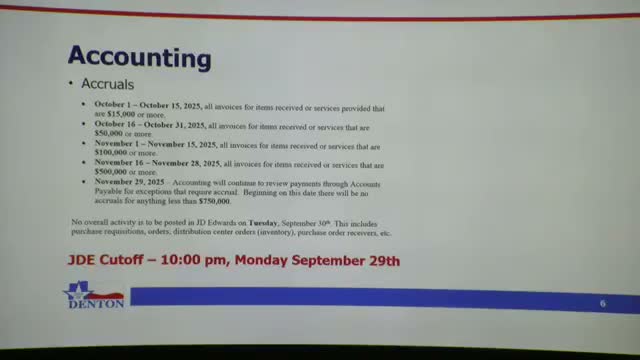
Why it matters: receipts and the system receiving date in the city's JD Edwards (JDE) financial system determine which fiscal year records an expense. Becky Pugh, the city controller, warned that missing the receiving cutoff can push costs into the next fiscal year and affect department appropriations. "You have until 10:00 to go out and receive those," Pugh said, explaining that receiving items in JDE is what records the expense. Pugh said the JDE cutoff on Sept. 29 will be followed by a system blackout on Sept. 30 with normal operations resuming Oct. 1.
Accounting and accrual thresholds: Pugh described the accounting practice of applying accrual thresholds as the city moves away from fiscal year end. She said that for payments made Oct. 1–15 the accrual threshold is $15,000 and that thresholds will rise as the period to close the year lengthens, later reaching $50,000. "So from October 1 to October 15, that threshold is gonna be $15,000," she said, adding that invoices below the threshold may not be accrued into the prior fiscal year even if they were received after the cutoff.
Budget implications: Hamilton noted that the adopted budget is the legal appropriation for the year and departments must avoid exceeding it. He urged departments to close purchase orders and encumbrances and to notify the budget office of any expected large invoices. "If you have a $5,000 invoice ... it may go into 2526," Hamilton said, describing how missed receiving can shift charges across fiscal years and reduce next year's available appropriation for a department.
Procurement deadlines, thresholds and itemization: Laurie Huel, purchasing manager, reviewed purchasing deadlines and rules. She said Sept. 5 is the last day to enter operating‑budget requisitions (ORs) for the current fiscal year; ORs may still be entered for job/project budgets after that date. Huel stressed that departments should leave purchase orders open if goods or services are expected after fiscal close so the PO can be received and closed in the next fiscal year.
Huel described a statutory change raising the noncontract small‑purchase threshold from the current level to $100,000 effective Sept. 1, but she said the city cannot apply the new threshold until the city's purchasing manual and policy are updated. "The law got passed and it'll go into place September 1, but we actually can't change it in the city of Denton until I get my purchasing manual and my policy updated," Huel said.
She also reiterated itemization rules: requisitions and purchase orders generally must be itemized to match quotes or contracts; construction and professional services contracts may remain lump sum. Sole‑source justification forms are valid for one year and should be renewed annually.
Operational guidance and tools: Adams described AP processes and communication channels: invoices should be sent to the city's Scanman inbox in a filename format including vendor name and PO and indicating whether the invoice has been received. She encouraged use of JDE's AP Invoice Viewer and the Q&A queue for official communications about invoices. Pugh and Huel pointed staff to SharePoint resources, JDE user guides, a newly created receiver report shortcut, and the recorded presentation for reference.
Other details mentioned: Adams noted 5–10 vendors provide prompt‑payment discounts of about 2%–5%, which reduce department budgets when applied. Pugh said per diem amounts change Oct. 1 and mileage rates change Jan. 1. Huel encouraged use of the Excel OR import and available guidance on NIGP codes and HUBS to support local and small business participation.
Staff said procurement and finance teams are available for follow‑up questions and will circulate the memo and presentation materials to departmental staff.
Ending: The departments were urged to act now to receive goods and submit invoices before the system cutoff and to contact accounts payable, accounting, or purchasing for clarifications or exceptions. The presentation recording and related documents will be posted for staff review.