Get Full Government Meeting Transcripts, Videos, & Alerts Forever!
Get email alerts on the Infrastructure Finance topic
No spam. Unsubscribe anytime.
Laguna Beach receives public input on West Street undergrounding; council asks for more bond analysis
Summary
At a public meeting, staff reported updated project costs for the West Street undergrounding assessment district and council directed further review of bond-purchase options including a briefing from the investment committee before deciding whether the city should buy the bonds.
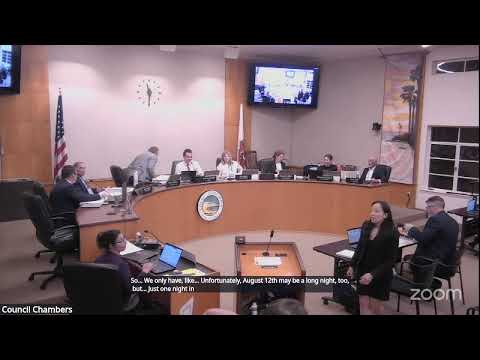
Laguna Beach held a public meeting July 22 on the proposed West Street Underground Utility Assessment District, where residents pressed the council for clarity about project costs, ballot procedures and the city’s proposed bond-financing options.
Pierre Sawaya, the city’s capital program manager, told the council the project’s construction estimate had fallen by roughly $800,000 after San Diego Gas & Electric completed competitive bidding on some work; that, together with bond-finance refinements, reduced the district assessments by about 15–20% for impacted parcels, Sawaya said. He also outlined three ways to place municipal bonds to pay for assessments: a public offering, a private placement (bank purchase) and a city internal purchase (city buying its own bonds).
“Public offering bond purchase would be for a 25-year term… private placements are generally limited to 20 years, and a city purchase would carry different risks and possibly lower fixed costs,” Sawaya said. He told council the estimated bond proceeds would be about $4–5 million and the assessment ballots will be mailed to property owners ahead of a public hearing scheduled for September 23.
Residents at the meeting voiced a mix of support and opposition. Several said they support undergrounding for long-term wildfire safety; others said the petition and assessment process felt opaque as numbers changed during planning. Jill Tracy, a resident and utility-risk professional, urged approval on safety grounds: “Undergrounding is the only permanent fire mitigation technology that we are aware of today,” she said.
Opponents raised procedural concerns: multiple recalculations of assessments, whether residents could have voted on a change in methodology, and whether the city should be using rule 20A (utility funding) or city funds for critical evacuation-route sections. Several residents said they were surprised by assessment increases after earlier estimates; staff explained those adjustments reflected engineering refinements and the discovery that some poles and wires near district parcels were outside previously assumed boundaries.
On the financing question, council members asked for more analysis instead of deciding tonight. Council directed staff to return with a focused analysis from the investment committee and the city treasurer comparing a city purchase of the bonds with a public offering, examining interest-rate assumptions, maturity constraints and the city’s investment policy limits (including whether a 5% portfolio cap would apply). The city’s finance director noted the city’s current investment policy language changed in 2024 and council asked staff to confirm policy limits before any internal purchase.
Sawaya said ballots will be opened publicly at the September hearing; if the ballots approve the assessment, the bond sale is anticipated in late 2025 and construction would follow in 2026. Council did not authorize financing tonight; it instead asked for additional due diligence and a formal investment-committee recommendation before a financing choice is made.