Get Full Government Meeting Transcripts, Videos, & Alerts Forever!
Get email alerts on the Parks And Recreation topic
No spam. Unsubscribe anytime.
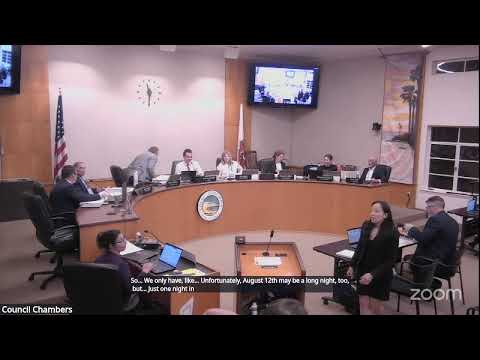
Laguna Beach council backs feasibility study for pump track at Moulton Meadows
Summary
After hours of public comment, Laguna Beach council directed staff to study feasibility and coordinate with the County of Orange and local bike groups on a bike pump track proposal centered on Moulton Meadows Park.
Laguna Beach city council on July 22 directed staff to study the feasibility of a bike pump track — a compact paved recreation track for wheeled, non-motorized use — and to pursue coordination with the County of Orange and local biking organizations about siting and funding.
The action came after a staff presentation from Alexis Braun, acting director of community services, and roughly an hour of public comment that included riders, parents and local business representatives who said the amenity would serve youth, encourage outdoor recreation and relieve pressure on informal dirt jump areas already built on the proposed site.
“Most pumptrack facilities have two tracks for all skill levels, one for younger and more inexperienced riders, and one for the general public of all ages,” Braun told council, describing the Moulton Meadows parcel north of the park’s soccer field as the Recreation Committee’s recommended site. Braun said San Clemente’s recently opened pump track cost about $619,000 and was funded primarily by private donors, with an approximate $305,000 city contribution.
Supporters, including David Browning of the Orange County Mountain Bike Association, told council pump tracks draw families and provide a safe place to learn bike skills: “Pump tracks are compact, low-maintenance facilities that offer something for everyone, from toddlers on balance bikes to seasoned riders,” Browning said.
Speakers who live near Moulton Meadows or use the park urged caution, citing wildlife corridor concerns and the site’s location within Aliso and Woods Canyon Wilderness Park. Several residents suggested alternative locations or criticized potential grading and habitat impacts. The council discussed tradeoffs at length, including whether a reduced-footprint option on adjacent city-owned turf might reduce grading and environmental permitting challenges.
Council members said they wanted the project pushed forward but with more detail before any land transfers or construction commitments. The council motion, seconded and approved, directed staff to: (1) move forward with a feasibility study for the Recreation Committee’s recommended site at Moulton Meadows; (2) explore alternative sites and engineering constraints on city-owned turf adjacent to the soccer field; (3) coordinate with the County of Orange on possible land-transfer approaches and habitat mitigation trade-offs; and (4) work with the Orange County Mountain Bike Association on fundraising and grant opportunities.
The council asked staff to return with engineering-level cost guidance, an environmental/permit pathway and options to minimize habitat impacts. No construction or funding was approved; the motion was a direction to continue study and outreach.
Council member comments reflected a mix of urgency and caution: several said the city should act while local interest and donor momentum exist, while others emphasized protecting nearby open space and minimizing grading. Braun said a preliminary engineering review and community outreach would be the next steps.
The council’s direction formalizes a pathway many residents have pushed for and starts the city-side coordination with county parks and local cycling organizations that the Recreation Committee and the applicant have requested. If engineering and permitting show the site to be feasible, the council signaled willingness to pursue a combination of private fundraising and limited city support to build and maintain the facility.
If the feasibility work recommends substantial grading or habitat impacts, staff were asked to return with alternative sites for council consideration.