
Needham committee recommends new FAR formula, attic credit and sliding lot coverage to limit ‘‘bulk’’ of new homes
Get AI-powered insights, summaries, and transcripts
Subscribe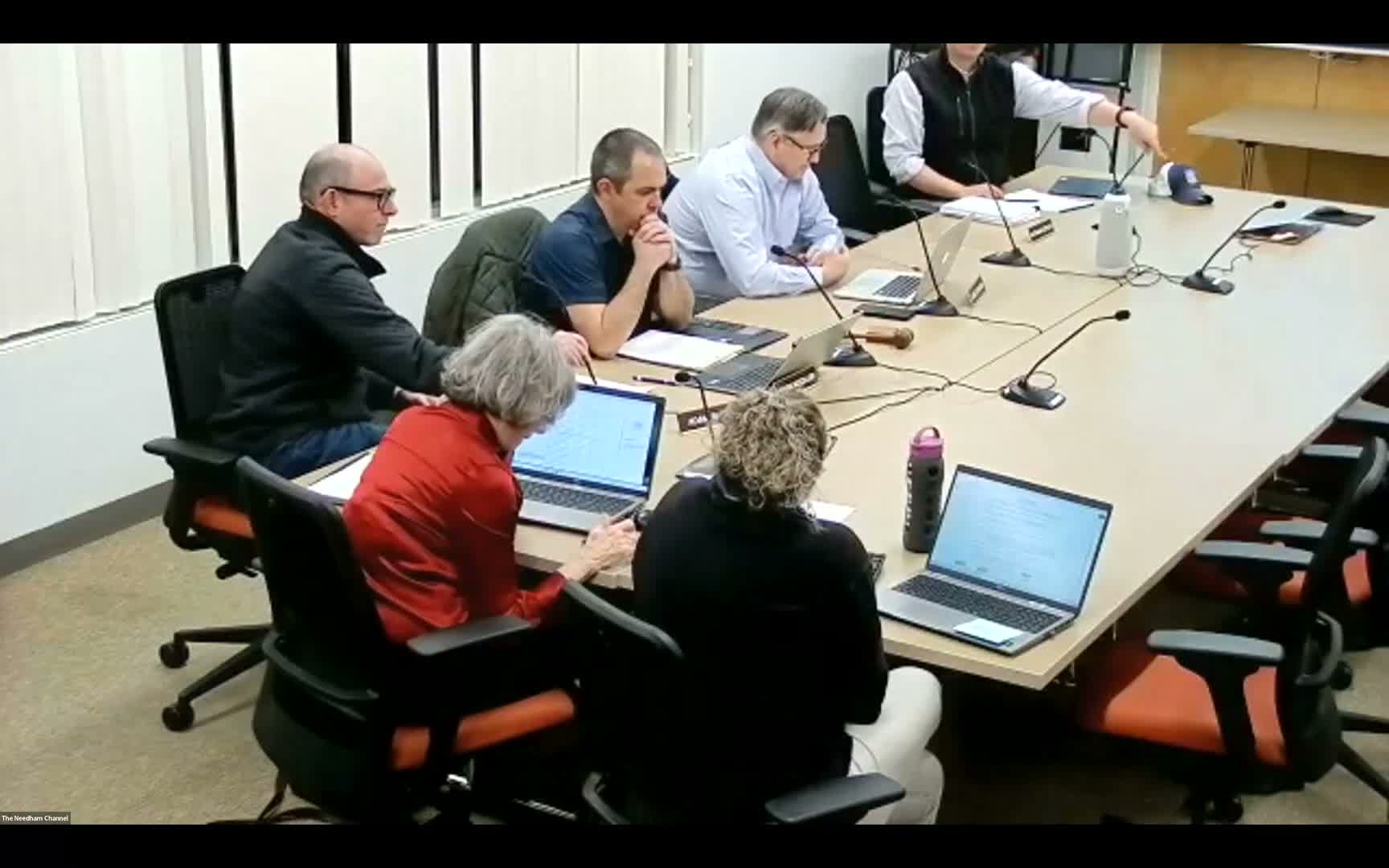
Summary
The Large House Review Study Committee presented four zoning changes — new FAR measurement, a 300‑sq‑ft attic credit, a sliding lot coverage scale and modest height and setback changes — and recommended option B after modeling and fiscal analysis. The Planning Board discussed tradeoffs and next steps toward public hearings and Town Meeting.
The Needham Planning Board on Tuesday heard a detailed presentation from the Large House Review Study Committee, which recommended four zoning bylaw amendments aimed at reducing the visual bulk of newly built single‑family houses.
Committee co‑chair Moe Handel said the group spent about a year interviewing officials, running architectural modeling and a fiscal analysis and reviewing comparable bylaws in nearby towns before assembling four separate draft articles for Town Meeting. "We were aware of the need to come up with practical recommendations that took into account the legitimate needs of residents who wanted a benefit from the sale of existing homes, their neighbors who remained behind, and whose perceived quality of life is affected by rapid and dramatic changes to the architectural fabric of their neighborhoods," Handel said.
Oscar Mertz, an architect on the committee, described the package’s centerpiece: a revised floor‑area‑ratio (FAR) calculation that counts all above‑ground area — including a third floor and garages — rather than only first and second floors. The committee proposes a stepped, sliding FAR tied to lot size to proportionally favor smaller lots, and a maximum house size enacted as a square‑foot cap that comes into play on lots of 15,000 square feet or more.
Mertz said the committee also proposed a 300‑square‑foot attic credit. "We kicked around numbers, but we landed on a 300 square‑foot allowance that would be a credit against whatever you do in the attic," he said, explaining the allowance is intended to encourage pitched roofs and finished third floors rather than pressure to flatten rooflines. The committee recommended counting a basement as a story only when it is more than 50 percent exposed above ground.
Paul McGovern, a builder‑developer on the committee, and staff members Lee Newman and Alex Klee said the group modeled several formula options (labeled A, B and C) and tested impacts on recent local sales. The committee voted to recommend option B; presenters reported the committee vote as 10–3 in favor of that option.
Fiscal analysis and market impact
Presenters showed updated fiscal tables using MLS and Zillow sales data for 2023–2025 and consultant estimates of how allowable livable square footage would change under each option. The consultant figures presented included illustrative impacts on teardown and rebuild economics: for a 10,000‑square‑foot lot the analysis showed estimated reductions in teardown/rebuild value of roughly $26,000 under option A and about $41,000 under option B, figures presenters said came from their methodology and the sales table.
Several Planning Board members raised questions about the fiscal analysis and about potential unintended consequences. Board member Adam said he did not find the assessment of the change in land (dirt) value persuasive and asked the committee and consultant for a clearer explanation before Town Meeting. "I just cannot understand how the acquisition, the dirt value of a lot has a $40,000 impact when you're reducing the marketable value of the property by 20 percent," he said, urging more vetting of the consultant’s assumptions.
Dissent and complexity
A minority of committee members and some board members urged a more conservative approach or said the formula complexity could create confusion and loopholes. One dissenting committee member said he favored counting fewer attic areas and described the proposed formulas as potentially hard for the public to understand.
Other dimensional changes
In addition to the FAR formula, the committee proposed a sliding lot coverage schedule (higher proportional coverage on smaller lots, decreasing toward 17 percent coverage at 15,000 sq ft), a modest reduction in maximum height tied to plate and ridge measurements and a front‑setback rule that sets a minimum 20‑ft front yard but preserves the block average where that average is greater than 20 feet (with ZBA relief for unusual geometries).
What’s next
The committee and staff said the four topics will be transmitted as separate draft zoning articles for public hearings: (1) FAR formula changes, (2) lot coverage sliding schedule, (3) height modifications, and (4) front‑yard setback language. The Planning Board asked for additional clarification on the fiscal study and for public outreach materials that explain the proposals in summary form. Committee materials and the modeling slides were presented to the board and will be posted online for the public ahead of hearings.
The board did not take a zoning vote Tuesday; instead, planning members and staff will schedule public hearings, publish the supporting materials, and follow the standard Town Meeting article process.