Get Full Government Meeting Transcripts, Videos, & Alerts Forever!
Get email alerts on the Emergency Medical Services topic
No spam. Unsubscribe anytime.
Board awards exclusive ambulance services contract to AMR after RFP
Summary
Monterey County approved a new exclusive operating area contract for ambulance services with American Medical Response following a competitive RFP and state review; the agreement includes new operational, clinical and equity-focused provisions and a transition period before operations begin Feb. 1, 2026.
Monterey County supervisors voted unanimously July 8 to award the county's exclusive operating area (EOA) contract for advanced life support and basic life support ambulance services to American Medical Response (AMR).
The agreement, recommended by county EMS staff after a statewide-approved RFP, establishes a transition period once the contract is executed and an operational start date of Feb. 1, 2026. The contract includes service areas for 9-1-1 response, interfacility transport and critical care transport, plus dispatch responsibilities.
County EMS presenters said the RFP aimed to preserve an EOA to maintain consistent service levels across Monterey County. The panel reviewed two responsive proposals and recommended AMR based on clinical performance, operational capacity, dispatch quality and cost considerations. "The agreement is unique in that it becomes effective from the time that the agreement is executed," one EMS staff member told the board, noting the transition window will let the contractor and county implement new programs and hold the contractor to its transition commitments.
AMR management told the board the company will support increased unit-hours and a phased transition to type-3 (box-style) ambulances and expand lower-acuity BLS response capacity alongside paramedic-level CCT and a nurse navigation program to identify patients who can be diverted from emergency transport. Those programs, staff said, are designed to reserve paramedic-level resources for higher-acuity calls while improving system-wide care.
AMR's vice president of operations, Mike Rice, discussed concerns about reimbursement for certain transports and said the company is researching county-specific billing questions and state fee schedules: "Typically, governments pay on a fee schedule much like medical and Medicare," Rice said, adding AMR will help stakeholders if state-level advocacy is needed.
Board members pressed staff and AMR on rural coverage and apparent unpaid transport liabilities associated with certain institutional users; staff said mutual aid agreements and deployment planning are intended to ensure southern and more remote coverage.
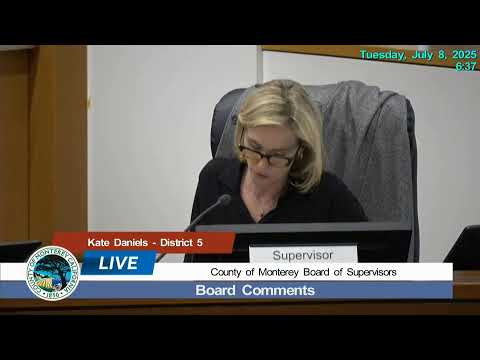
The board's vote to approve the agreement followed a motion by Supervisor Alejo, seconded by Supervisor Daniels, and passed by roll call (Alejo, Church, Askew, Daniels and Chair Lopez all voting aye). Staff said the contract contains performance standards tied to optional extensions and requires AMR to meet clinical scorecard and equity data-reporting obligations.
What happens next: AMR and the EMS agency will implement the transition plan and set up the clinical scorecard, equipment and training upgrades, and dispatch arrangements during the execution-to-start window. The county said it will monitor response times, clinical metrics and disaggregated data to identify any 'pockets of inequity' and require corrective actions if needed.