Get Full Government Meeting Transcripts, Videos, & Alerts Forever!
Get email alerts on the Body Worn Cameras topic
No spam. Unsubscribe anytime.
Police commission approves clarifications to body-worn camera policy pending meet-and-confer
Summary
The San Francisco Police Commission voted to adopt clarifying edits to Department General Order 10.11 on body-worn cameras, including that officers may review only their own video after officer-involved shootings; the changes are subject to meet-and-confer with the Police Officers Association.
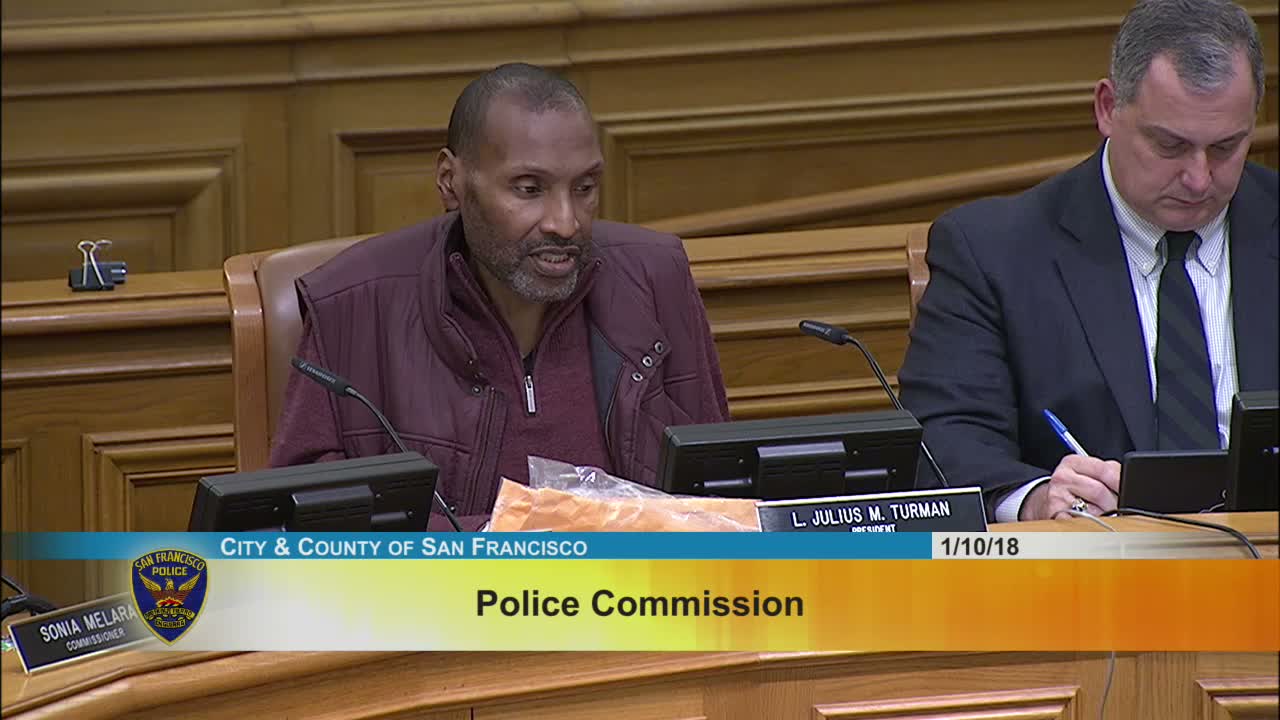
The San Francisco Police Commission voted Jan. 10 to adopt a set of clarifications to Department General Order 10.11 governing body-worn cameras, with the changes to be finalized through the required meet-and-confer process with the Police Officers Association.
The commission’s action, taken by voice vote after public comment, responds to language commissioners and department staff said had led to inconsistent interpretation during the policy’s two years of use. Terri Dilshaw introduced the item and Chief William Scott summarized the edits, saying department staff wanted to ensure a clear definition of activation and to remove ambiguity about what constitutes deactivation. "Turning off the LED lights is not a deactivation," Scott said, explaining the change was intended to address officers' tactical concerns while preserving evidence practices.
Other clarifications approved pending bargaining include stricter wording around failure to activate cameras; the order now reiterates that failing to turn on a camera when appropriate "may" trigger an administrative investigation and, if warranted, discipline. Commissioner Hirsch questioned the discretionary language, arguing an investigation should follow every failure to comply, saying the term "may" leaves too much discretion.
The commission also tightened post-incident review procedures for officer-involved shootings and in-custody deaths: a subject officer must provide an initial statement before reviewing video, and the policy was revised to make explicit that officers may review only their own body-worn camera recordings, not fellow officers' footage. Commissioner Mazuko said that limitation reflected the commission’s original legislative intent: "the officers only to view their own cameras and footage for the integrity of the investigation."
The draft additionally authorizes the department to disable a camera "mute" function and directs technology and professional-standards inspections to monitor activation compliance. Chief Scott said the department’s professional standards bureau will inspect body-worn camera use and that records of activation and reviews can be revisited if data show widespread noncompliance.
Public comment during the item included speakers who urged broader accountability; one attendee identifying himself as Ace Washington criticized city policy but was directed to the general public comment period. After discussion, a commissioner moved to accept the clarifications pending the meet-and-confer process; the motion was seconded and approved by voice vote with no recorded opposition.
The commission’s approval will be followed by labor discussions with the Police Officers Association before final language is adopted and posted.