Get Full Government Meeting Transcripts, Videos, & Alerts Forever!
Get email alerts on the Clean Power Sf topic
No spam. Unsubscribe anytime.
SFPUC lauds Clean Power SF growth, plans budget-billing and IRP amid PCIA uncertainty
Summary
Clean Power SF reported serving more than 400,000 accounts with high retention, won a C40/Bloomberg award and announced a new opt-in budget-billing program; staff warned an expected PG&E exit-fee (PCIA) change could force Clean Power SF rate adjustments and is drafting a 2020 integrated resource plan.
San Francisco ' The San Francisco Public Utilities Commission heard a quarterly update on Clean Power SF on Nov. 12, with staff reporting program growth, a national award and new customer offerings while warning of price pressure from state-regulated utility charges.
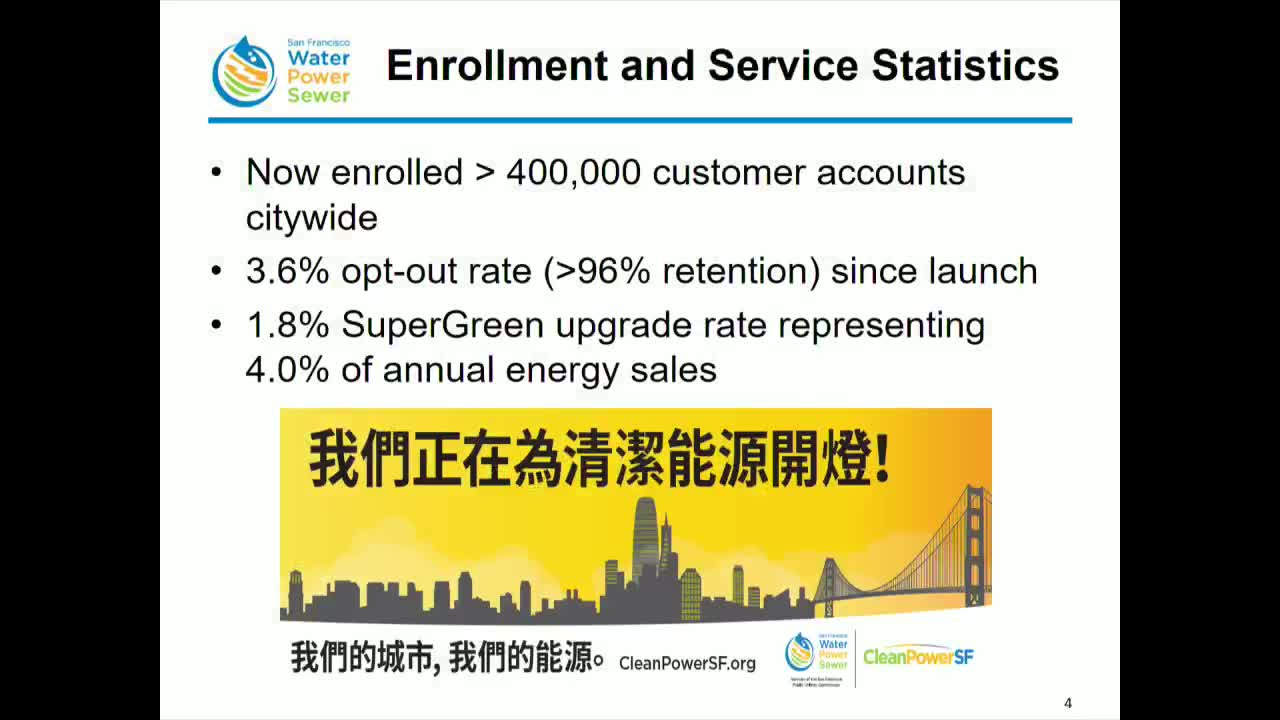
Assistant General Manager for Power Barbara Hale introduced the update and asked staff to report enrollment and service statistics. Mike Himes, director of Clean Power SF, told the commission the program now serves "over 400,000 accounts" with "about 3.6%" opting out and a 96% retention rate; 1.8% of enrolled customers selected the program's 100% renewable "Super Green" option, representing "about 4% of our annual energy sales." Himes also presented an international recognition: Clean Power SF won an award from C40 Cities and Bloomberg Philanthropies for the program's launch and growth.
Himes said staff will begin a soft launch this month of a new, opt-in budget-billing option that bills participating customers on a 12-month usage average to smooth seasonal swings and said the program will be marketed citywide in January. "Under budget billing, participating customers will be billed based on an average of the past 12 months of usage," Himes said, explaining the intended effect on monthly bill predictability.
But Himes told the commission staff is watching rates set by Pacific Gas & Electric and state proceedings closely. He said forecasts show an increase in the power charge known as the PCIA (Power Charge Indifference Adjustment) and a decrease in PG&E's generation rates; that combination could require Clean Power SF to lower its own rates to remain competitive.
"The combination of these two changes may mean that we would need to decrease Clean Power rates to continue to offer a competitive service," Himes said. Staff plans a rate action with a conditional delegation to management, and is preparing a second biannual integrated resource plan (IRP) that will model long-term customer demand, the program's renewable and greenhouse-gas targets, and options for local investment.
Public commenters urged greater transparency about the PCIA's growth and called for more distributed generation and microgrid planning to boost local resilience. Board members pressed staff for regular updates as state proceedings evolve.
The commission did not take a separate vote on the Clean Power SF report; staff said follow-up items including the rate action and IRP will be returned for formal consideration in coming months.