Get Full Government Meeting Transcripts, Videos, & Alerts Forever!
Get email alerts on the Land Use Development topic
No spam. Unsubscribe anytime.
Two developer teams present competing visions to reactivate Pier 38 bulkhead
Summary
Two respondent teams — San Francisco Waterfront Partners 3 and TMG Pier 38 Partners — presented alternate Phase 1/Phase 2 plans for Pier 38 bulkhead rehabilitation emphasizing public access, historic preservation, near‑term activation of restaurants and offices, and different approaches to timing and tenant mix.
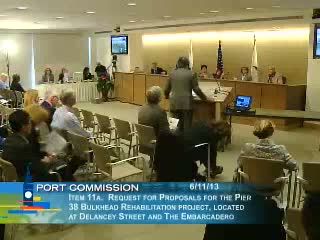
Port planning staff introduced two respondents to the Pier 38 bulkhead rehabilitation request for proposals and gave each team time to present their vision for reactivating the bulkhead building and adjacent pier areas.
San Francisco Waterfront Partners 3 (represented by Simon Snelgrove and Alicia Alban) stressed pedestrian access, preservation of public views, phased re‑tenancy with 21,000 square feet of office and restaurant space in Phase 1, and a larger Phase 2 that would extend public access around the pier and add a 5,000‑square‑foot public event space. The team said the short‑term approach would allow reactivation of the bulkhead while pursuing entitlements for the full pier in parallel and highlighted prior waterfront projects and commitments to local business enterprise (LBE) goals.
TMG Pier 38 Partners (Michael/Covarrubias, Amy Neches, Matt Field) emphasized an expedited activation strategy using an interim dining pavilion and food‑truck model to avoid heavy early permitting while creating a vibrant waterfront edge. TMG described a less‑invasive near‑term rehabilitation to avoid triggering large seismic upgrades immediately, followed by a long‑term rehab focused on office tenants and historic preservation. TMG said food‑truck activation can provide immediate vibrancy with fewer initial capital improvements.
Both teams addressed preservation, public access and long‑term revenue generation; commissioners thanked the teams and said the evaluation panel will score written proposals and interviews and return a staff recommendation at a future meeting. Staff said the evaluation panel will convene the following week and staff hopes to bring a recommendation to the commission in September.