Get Full Government Meeting Transcripts, Videos, & Alerts Forever!
Get email alerts on the EIS topic
No spam. Unsubscribe anytime.
Commission hears EIS data, uses-of-force multipliers and plan to refine alerts with University of Chicago
Summary
SFPD presented EIS fourth-quarter results, explained how counting "pointing of a firearm" multiplies uses-of-force counts and described a partnership with the University of Chicago to improve EIS accuracy and reduce false alerts.
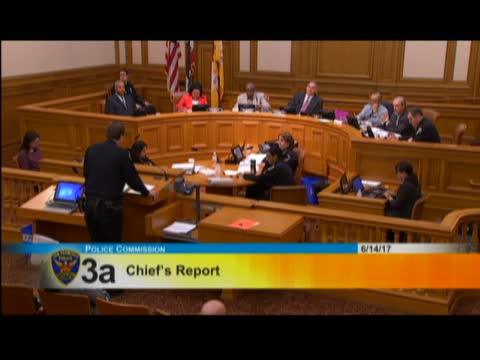
Sergeant Stacy Youngblood presented the SFPD Early Intervention System (EIS) fourth-quarter 2016 findings to the Police Commission, explaining what triggers alerts and how the department counts uses-of-force.
Youngblood described 10 primary indicators (including officer-involved shootings, uses of force, complaints and collisions) and explained thresholds that generate an alert packet for supervisory review. He walked commissioners through how the department counts instances of pointing a firearm: "Simply put, if we had a robbery vehicle and... all 4 of the officers are pointing their firearms at the vehicle with, let's say, 4 individuals in it... That gives us a count of 16 uses of force," the presentation said.
The presentation included data: in some quarters point-of-firearm incidents account for a large share of uses of force, and alerts by station (Mission, Bayview, Tenderloin) reflected call volume and population density. Youngblood described interventions, with a small number of formal interventions opened in 2015–2016 and several active interventions ongoing for issues such as failure to appear and tactical communication.
Commander Walsh and Youngblood described a partnership with the University of Chicago to examine and improve EIS indicators. They said the university estimates it can "improve the accuracy of EIS as much as 20% and reduce the number of false alerts by more than 50%," and outlined plans for site visits, officer focus groups and analytic work to refine thresholds.
Commissioners asked how many interventions result from alerts and whether supervisors intervene earlier; SFPD staff said many supervisory counseling actions are currently not captured in formal EIS statistics but will be reported in future quarterlies to better reflect early interventions.