Get Full Government Meeting Transcripts, Videos, & Alerts Forever!
Get email alerts on the Transportation Assessment topic
No spam. Unsubscribe anytime.
SFMTA launches waterfront transportation assessment covering Crissy Field to Hunters Point Shipyard
Summary
SFMTA's Peter Albert said the assessment expands study boundaries to the full waterfront, will publish goals-and-strategies this summer, and will use community workshops and America's Cup lessons to develop multimodal solutions ahead of year-long solutions analysis.
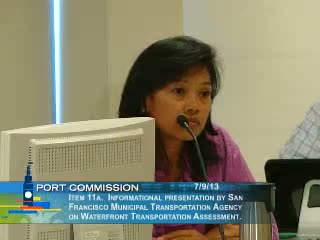
Peter Albert of the San Francisco Municipal Transportation Agency told the Port Commission that the Waterfront Transportation Assessment has entered a public goals-and-strategies phase and the study area now runs from Crissy Field to the Hunters Point Shipyard. "We're not just talking about a limited part of the waterfront anymore, we're looking at the waterfront all the way from Crissy Field down to the Hunters Point Shipyard," Albert said.
Why it matters: The assessment aims to align a pipeline of major land-use projects with transportation investments so transit, pedestrian, bicycle and ferry service scale with growth. Albert said outreach has included workshops tied to large projects (Warriors, Giants at Mission Rock, Pier 70) and lessons learned from the America's Cup and the recent BART strike.
Albert described a two-stage approach: finish the goals-and-strategies draft this summer, then begin a solutions-analysis phase that could last about a year and provide high-level modeling to coordinate mitigations across multiple EIRs. The assessment will consider multimodal needs — transit, paratransit, taxis, bicycle facilities, pedestrian circulation and funding strategies — and is intended to feed mitigation measures into future EIRs for waterfront projects.
Commissioners asked about interim tactical fixes while the long-range analysis continues; Albert pointed to pilot projects already deployed this summer (green paint on bike lanes, expanded E-line service) and said that the America's Cup pilots are informing near-term implementation. He also committed to follow up on signal-timing work on the Embarcadero and to report back on water-transport coordination (WETA, Blue & Gold, Golden Gate Ferry) and how temporary increases in ferry service could be made more robust.
Next steps: public workshops through September (including a July 24 Warriors subcommittee workshop) and additional outreach on funding and implementation. The agency has posted the assessment draft on OEWD/Pier30-32 web pages for public review.
The commission did not vote on policy during the briefing; staff will return with more detailed analysis and pilot outcomes.