Get Full Government Meeting Transcripts, Videos, & Alerts Forever!
Get email alerts on the Stormwater Billing topic
No spam. Unsubscribe anytime.
SFPUC adopts rules to bill unmetered parcels for stormwater runoff
Summary
The commission adopted rules to apply existing sewer service charges to roughly 500 unmetered parcels using a tiered Effective Impermeable Area metric, with an appeals process and an $8 million grant program for incentives and outreach.
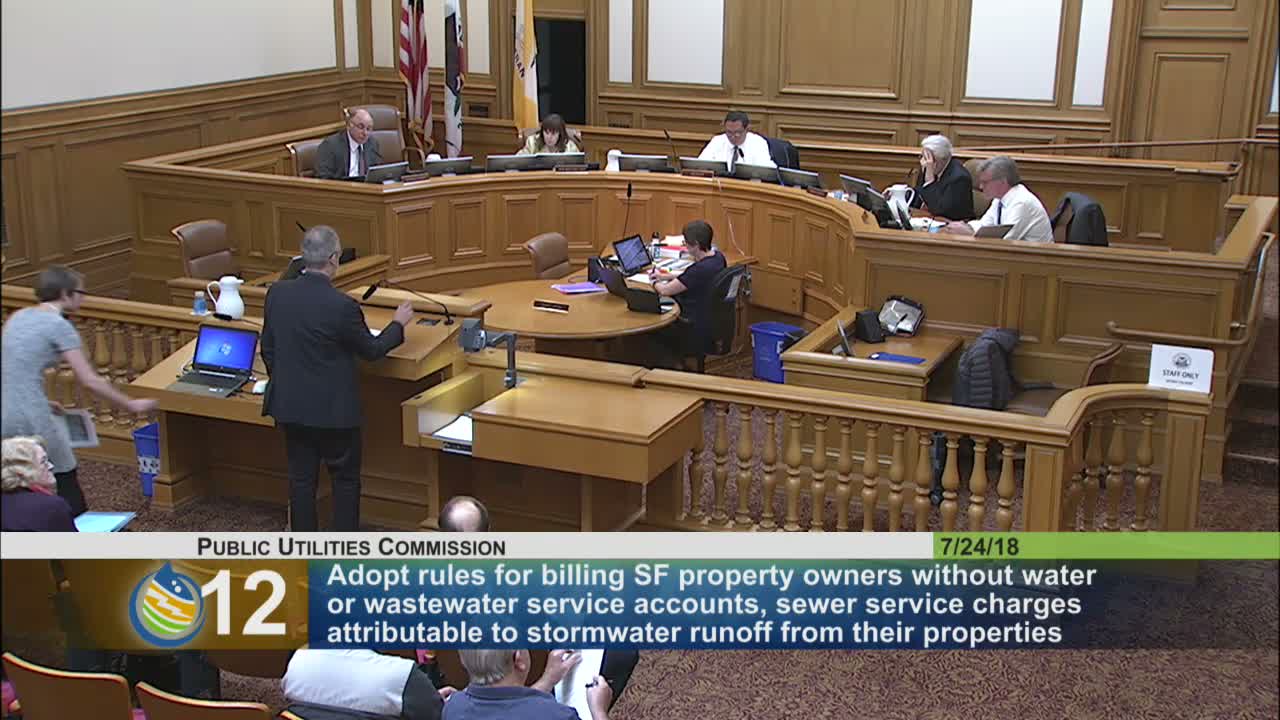
The San Francisco Public Utilities Commission voted July 24 to adopt rules to bill properties without water meters for their portion of sewer service charges attributable to stormwater runoff.
Erin Franks, a principal rates analyst, explained the proposal applies an existing sewer service charge to unmetered parcels by calculating an Effective Impermeable Area (EIA) — impermeable area plus 10% of permeable area — and grouping parcels into three tiers: de minimis (EIA under 500 sq ft, exempt), low‑runoff (500–1,300 sq ft, approximately two‑thirds of the standard charge) and standard runoff (higher EIA). Franks said staff calculated EIA for the roughly 500 unmetered parcels and proposed implementation in October 2018, with an appeals process and a planned $8 million grant program to promote green infrastructure and owner participation.
"We're beginning this work by making sure that we have a way to apply our existing sewer service rate to these unmetered properties," Franks said. She also told the commission that parcels adjacent to metered accounts may be exempt if they are part of the same customer account and that new meter installation would remove an unmetered parcel from the charge.
Commissioners asked how appeals would work and whether the methodology would later apply to metered customers; staff said the review procedure will include site visits and the long‑term goal is to roll incentives and credits into the next rate study. After public comment and a short Q&A, a commissioner moved the item, it was seconded and adopted by voice vote.
Next steps: staff will implement the billing changes in the billing system, finalize outreach materials and begin the grant program and the appeals process described in the adopted rules.