Get Full Government Meeting Transcripts, Videos, & Alerts Forever!
Get email alerts on the Capital Plan topic
No spam. Unsubscribe anytime.
Port presents $956 million 10-year capital plan, flags reliance on bond proceeds and transferable development rights
Summary
Port staff presented the seventh iteration of a 10-year capital plan that programs roughly $956 million across repair and enhancements, highlights volatile development revenue, and identifies infrastructure financing district bonds and transferable development rights (TDRs) as key future funding sources.
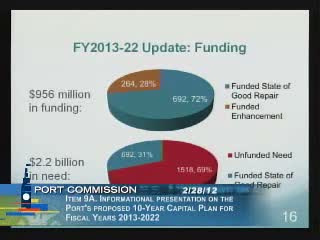
Port of San Francisco staff on the commission dais on March 1 presented a seventh edition of the port's 10-year capital plan, laying out roughly $956 million of programmed projects for fiscal years 2013'2022 and multiple funding scenarios to close a years-long shortfall.
Daley Dunham of the Special Projects Group, who said he has been one of the principal authors for seven years, told commissioners the plan now shows about 28 percent of programmed spending for enhancements and roughly 72 percent for state-of-good-repair work. He highlighted that moving to city-standard software modeling reduced some estimated needs and that Army Corps and inflation factors have increased dredging and industry costs. Dunham also said a seismic reassessment lowered the port's estimated need for Piers 27 and 29 by about $40 million after determining a cruise terminal use was seismically suitable.
The presentation called attention to the growing role of infrastructure financing district (IFD) bond proceeds and the volatility of development-dependent revenues. Staff identified transferable development rights as a potential new source, estimating up to $24 million in proceeds from selling vertical development rights over certain historic piers if a program is authorized. Dunham said the port would prefer to present amounts in millions rather than thousands to avoid an illusion of excessive precision in early-stage estimates.
Commissioners asked for clarifications about the modeling, funding assumptions and how the plan will be updated. Dunham said the plan is a living document that will return for revisions before final approval, and that the capital planning committee and Board of Supervisors would also review the package in a mid-cycle update. He emphasized the plan's role in helping the port access long-term instruments such as general obligation bonds.
The presentation also included project-level highlights: a now-complete Exploratorium development contribution that will drop off the ledger in 2013; a $3 million rail-repair effort aimed at unlocking a longer-term export terminal at Pier 94; and a large share of the program devoted to dredging and port-wide maintenance costs.
Next steps: staff will continue to refine the plan and present it to the Board of Supervisors and the Capital Planning Committee for review; any substantive changes will return to the commission for action.