Get Full Government Meeting Transcripts, Videos, & Alerts Forever!
Get email alerts on the Americas Cup Dda topic
No spam. Unsubscribe anytime.
Port staff outline America's Cup DDA, say private investment could cover major waterfront repairs
Summary
Port staff presented an updated Development and Disposition Agreement (DDA) for the 2013 America's Cup, saying the event authority would invest roughly $111.3 million in port improvements (NPV about $88.5 million) reimbursed by a defined waterfall of revenues; staff and the budget analyst flagged risk-containment recommendations.
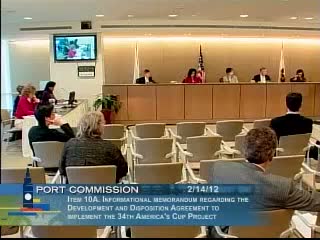
Port staff on Feb. 14 gave the Port Commission an informational briefing on revisions to the Development and Disposition Agreement (DDA) tied to the 2013 America's Cup, presenting the deal's repayment structure and a financial analysis showing private investment could address significant deferred repairs.
"The new DDA in front of you does govern and limit the way that authority infrastructure work is reimbursed for, but through port sources," Jonathan Stern, co-project manager for the port's America's Cup efforts, told commissioners as he outlined categories of work and the repayment waterfall. Stern described two buckets of work: "authority infrastructure work" (improvements needed to stage and complete the event, primarily at Piers 30–32) and "additional work" (deferred projects such as dredging and Pier 26/28 work).
Tom Houston, chief commercial officer of the event authority, emphasized the event's scale and expected benefits, saying the America's Cup is "the third largest sporting event in the world" in terms of economic impact and noting potential global visibility and tourism benefits. "This is a beautiful stadium, if you will, that's capable of having millions of live spectators around the entire perimeter of the Bay," Houston said.
Elaine Forbes, deputy director of administration and finance, presented staff's financial analysis: the authority infrastructure work is estimated at roughly $111.3 million, with a present value of about $88.5 million because some work can be deferred and paid over time. Forbes said staff modeled repayment sources — including the proposed sale of Seawall Lot 330, IFD (Infrastructure Financing District) revenue for Pier 30–32, interim leases for Piers 26 and 28, and a residual participation interest in Pier 30–32 — and found those sources nearly match the discounted cost estimate.
Forbes said short-term event-related impacts (lost rent, tenant relocation, security and staffing) are expected to be offset in part by a city general-fund contribution under a memorandum of understanding, and estimated near-term costs to the port of about $6.4 million with additional tenant-relocation and staffing costs of roughly $2.56 million.
Staff walked commissioners through "opportunity cost" calculations, noting the port's lost rent over the useful life of affected piers (about $52.5 million for authority infrastructure work) and arguing that the value of private investment and extended useful life of the assets could outweigh that lost rent. "While the event authority can be repaid $38.8 million for additional work, the opportunity cost of the port is only $14.9 million," Forbes said, describing how private money could leverage other financing tools (historic tax credits, IFD, long-term leases).
Budget-analyst recommendations highlighted in staff materials focus on containing risk: use of estimates (not uncapped actuals) for reimbursement calculations; a possible hard cap on spending; requiring Board of Supervisors review of post‑match expenditures on Pier 30–32 before approving long-term work; and earlier return of short-term venues to reduce general-fund payments for lost rent.
Jonathan Stern told the commission the DDA limits the port's reimbursement obligations by defining the sources of repayment and ordering them. He said the authority's potential repayment sources are close to the present-value estimate of authority infrastructure work, but cautioned the deal depends on multiple financing assumptions and future development outcomes.
During public comment, Hunter Cutting, a local sailor, urged the commission to make marina and small-boat facilities more certain in the DDA, arguing dredging and marina construction are optional in the current terms and may not deliver the legacy benefits for recreational sailors that advocacy groups expect.
Staff emphasized the item was informational. The DDA and related venue leases will return to the commission and will go before the Board of Supervisors in coming weeks; staff said they expected additional committee review and recommended edits before any binding approval.
Provenance: briefing and Q&A recorded in the transcript from SEG 1474 through SEG 2244.