Get Full Government Meeting Transcripts, Videos, & Alerts Forever!
Get email alerts on the Drought Planning topic
No spam. Unsubscribe anytime.
SFPUC details drought planning scenario as public commenters press for stronger environmental analysis
Summary
The San Francisco Public Utilities Commission reviewed its drought planning scenario—based on the 1987–92 sequence—and reaffirmed conservative planning to preserve supplies; members of the public urged greater attention to environmental impacts on the Tuolumne and Bay‑Delta.
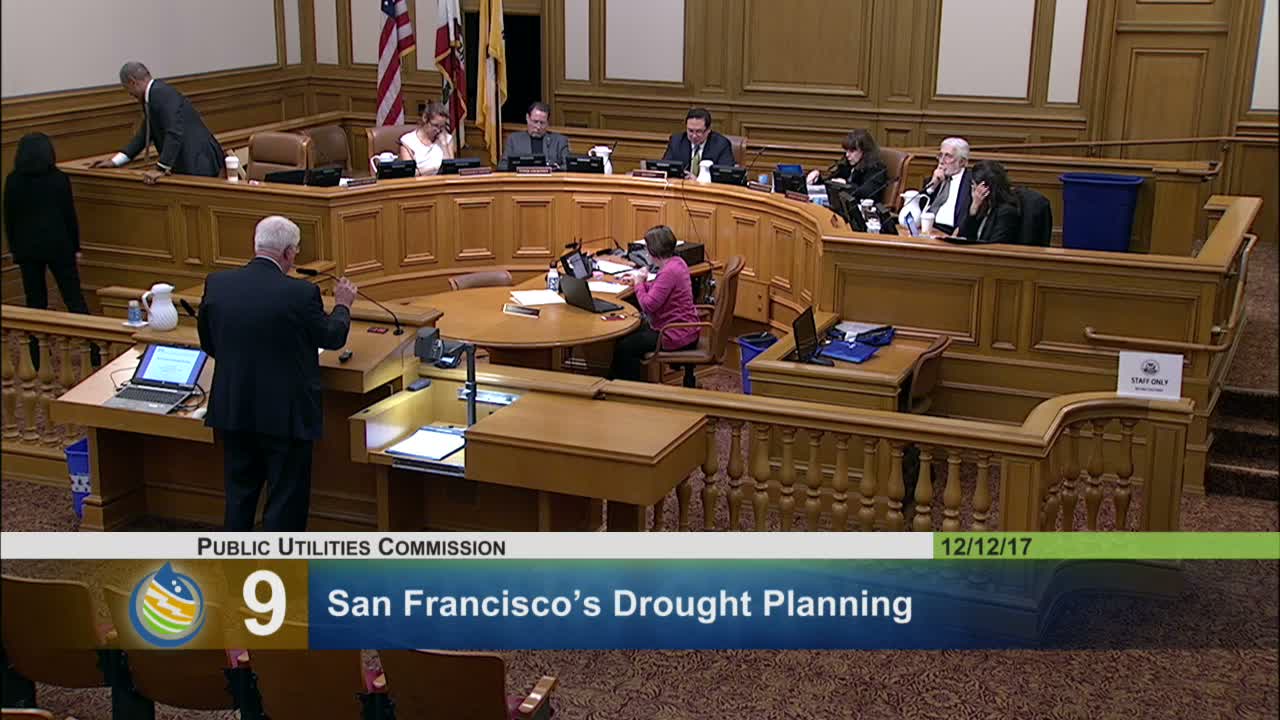
San Francisco Public Utilities Commission officials on Dec. 12 laid out the agency's drought planning framework and defended a conservative 'design-drought' scenario aimed at ensuring long-term water supply for city and wholesale customers.
Steve Ritchie, assistant general manager for water, said the SFPUC's planning scenario is built on the 1987–92 drought sequence and subsequent hydrologic analyses. "We expect this to become more likely in the future as a result of climate change," Ritchie said, adding that the plan is a scenario to prepare operations for extended droughts and staged rationing.
The presentation described how storage is used to move through progressively larger rationing triggers: first-year responses are deliberately measured because most droughts do not persist, Ritchie said, while longer sequences can trigger additional conservation and infrastructure operations. He noted the agency's rule curve approach is intended to preserve the ability to serve customers even under severe sequences and cited recent operational examples such as the temporary drawdown at Cherry Reservoir to perform valve repairs.
Public commenters pushed back on whether the 'design-drought' remains scientifically appropriate and asked the commission to weigh ecosystem impacts more explicitly. Peter Dreckmire raised concerns about how outside analyses and press accounts have cited SFPUC numbers, urging staff to review apparent misquotations and the assumptions behind impact estimates. "I was kinda shocked by the poor analysis," Dreckmire said regarding one report, and asked the commission to verify how figures were used.
Dave Warner, another commenter, asked the commission to press staff for environmental analyses that document harms to the Tuolumne and Bay-Delta ecosystem, and to consider adaptive management if non-flow measures prove insufficient. "We'd like to have a great, reliable water supply, but done with great environmental support," Warner said.
Commissioners and staff acknowledged those concerns. Ritchie said the planning scenario is intentionally conservative to ensure reliability and noted that operational decisions are adjusted to real-time conditions. Michael Carling, deputy general manager, told the commissioners that negotiations with the state on the Water Quality Control Plan and related environmental documents are ongoing and that some details remain confidential until the agency completes those processes.
Why it matters: San Francisco relies on storage- and rights-based supplies for both retail and wholesale customers; the drought plan guides near-term operational decisions and long-term projects such as groundwater storage and recovery. Public interest centers on whether the plan balances water reliability with the state's co-equal goals to protect ecosystems.
What's next: The SFPUC will continue its regulatory engagement with the State Water Resources Control Board and return to the commission with updates. Members of the public asked for more frequent reporting on environmental conditions in the Tuolumne watershed and clearer documentation of assumptions used in the 'design-drought' scenario.