Get Full Government Meeting Transcripts, Videos, & Alerts Forever!
Get email alerts on the Parking Policy topic
No spam. Unsubscribe anytime.
Port, SFMTA propose meters and demand pricing across Mission Bay and adjacent port streets
Summary
The Port Commission heard an SFMTA/Port presentation proposing meters, demand‑responsive pricing and new parking rules across Mission Bay, a surrounding buffer and a south‑of‑Third subarea. Officials said modest per‑hour charges and technology choices aim to increase space availability; Dogpatch residents voiced strong opposition.
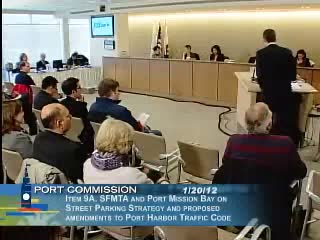
The Port Commission on Wednesday heard a joint presentation from Port staff and the San Francisco Municipal Transportation Agency on a proposed on‑street parking strategy for Mission Bay and adjacent port streets that would add meters and use demand‑responsive pricing.
SFMTA planner Jay Primus said the agency’s occupancy surveys show many blocks with parking occupancy “over 85%,” and that modest charges can free spaces. “All of these red lines mean that, it's parking occupancy is over 85%, which translates into an experience as a driver of exactly what we don't wanna see, where it's very difficult to find a parking space,” Primus said.
Under the staff proposal, meters would be installed in three subareas: Mission Bay proper, a Mission Bay buffer and a south‑of‑Third Street area. Meters in Mission Bay would operate from about 9 a.m. to 11 p.m. daily, with an MTA‑starting rate as low as $0.25 per hour; Port staff recommended a higher starting rate in some port‑jurisdiction blocks (about $1.25 per hour, with a 50¢ evening rate after 7 p.m.). Special‑event rates would continue to apply for stadium nights.
Primus framed the approach as a shift from fixed time limits toward availability, calling meters that accept credit cards and mobile payments a tool to manage supply: “Demand responsive pricing is really at the heart of it…our legal obligation to find the lowest rate possible, that achieves that 1 open space most of the time,” he said.
Commissioners asked how variable pricing would be managed and how the public would be notified of changing rates. Primus said new single‑space meters with GPRS modems allow central, real‑time adjustments, and staff will roll out pay‑by‑phone and stored‑value card options to reduce friction. He also said enforcement will begin with warnings for a month after meters go into extended evening hours to reduce surprise citations.
Public comment highlighted neighborhood differences. Dogpatch business owner Loring Sagan said the neighborhood is “not Mission Bay” and urged the Commission to delay implementation and increase outreach. Janet Carpinelli of GreenTrust SF supported parking limits near Warm Water Cove Park to address vehicle storage and safety but opposed blanket metering in Dogpatch. Corinne Woods, chairing the Mission Bay Citizens Advisory Committee, said Mission Bay was planned as a metered, transit‑first district and urged monitoring of pricing and retail impacts.
Staff said the SFMTA board will consider its portion of the program on Feb. 7; the Port will return in February to seek Port Harbor traffic code amendments to implement its portion of the meters. If the Commission approves, staff said implementation would begin this year and be phased block by block with continued outreach, rate monitoring and an initial enforcement grace period.
Next steps: SFMTA board consideration in February and a return to the Port Commission for code amendments and final approval before installation.