Get Full Government Meeting Transcripts, Videos, & Alerts Forever!
Get email alerts on the Body Worn Cameras topic
No spam. Unsubscribe anytime.
San Francisco Police Commission narrows issues but splits on when officers may view body‑cam footage
Summary
After hours of public comment and internal debate, the Police Commission directed staff to return two draft options for a six‑page body‑worn camera policy — one allowing officers to view footage before report writing and one delaying viewing in critical incidents — and asked for city‑attorney guidance on AB 69 retention and disclosure rules.
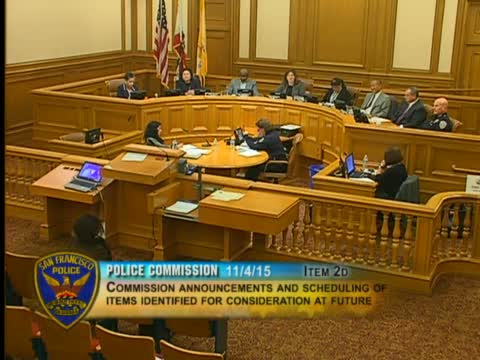
San Francisco’s Police Commission spent the bulk of its Nov. 4 meeting going line‑by‑line through a six‑page draft policy for department body‑worn cameras, advancing language on when officers must record and how recordings are stored while leaving unresolved a contentious question: whether officers involved in critical incidents may review footage before giving formal statements.
President Loftus opened the discussion by describing the working‑group process that produced the draft and by posting the document on the commission website. The draft draws on national guidance and California legislation, and the commission repeatedly referenced AB 69 as a set of retention and storage best practices to be reflected in the final policy, President Loftus said.
The commission reached early consensus on several items: members are “not required to activate or deactivate a body‑worn camera upon the request of a citizen,” and the policy should enumerate clear triggers for mandatory activation — including detentions and arrests, searches, traffic and pedestrian stops, transportation of detainees, and situations that may produce evidentiary value. Chief (identified in the transcript as chief/Chief Gregory P.) told the panel that cameras being procured include a pre‑buffer to capture several seconds of footage before activation, a technical measure the commission cited when debating whether officers must turn cameras on “prior to” an encounter.
But the panel split over two major issues. First, commissioners debated whether to add explicit language requiring officers to activate cameras during 5150 (mental‑health) evaluations and during vehicle or foot pursuits; after discussion the commission directed staff to add use‑of‑force, vehicle pursuits and foot pursuits to the list of enumerated triggers so officers know to turn cameras on in those circumstances.
Second — and most consequential — the commission could not agree on the rule governing officer review of recordings. Some commissioners, echoing many officers who testified in working‑group meetings, argued that reviewing footage before writing a report improves accuracy in high‑stress encounters and protects officers by allowing them to record their perceptions accurately. “In critical incidents … officers don’t necessarily remember exactly what happened,” Commissioner Mizuko said, and the video will ultimately adjudicate what occurred.
Other commissioners and many community speakers pushed the opposite view. Tessa D’Arcangelo of the ACLU of Northern California and other public commenters urged that officers involved in shootings or in‑custody deaths should be treated like any other witness or party: record an initial statement first, then permit coordinated viewing by investigators if appropriate. “These are not the times to be concerned about how officers are being treated, but rather how do we move forward in making sure that we rebuild community trust,” D’Arcangelo said during public comment.
Faced with the divide, the commission asked staff to draft two options for the section on viewing: (A) allow officers to view recordings prior to preparing routine reports and critical‑incident statements as currently drafted, and (B) prohibit officer review in enumerated critical incidents until after an initial formal statement has been given, with a supervised process to permit supplemental statements after investigative coordination. The chief, commander and OCC director were asked to collaborate on language and to consult the district attorney’s office; the commission also asked the city attorney to map the draft against AB 69 retention and disclosure guidance.
Other policy points the commission flagged for explicit drafting included: supervisory documentation when a recording is terminated, retention windows for non‑evidentiary footage (AB 69 suggests short retention where no arrest/detention/investigation occurs), procedures for uploading footage (the draft requires upload by the end of watch unless directed otherwise), and internal auditing and progressive discipline for failure to comply or for unauthorized release.
The commission left no decision final at the Nov. 4 meeting; President Loftus said staff will return two revised draft options and legal analysis for vote at the Dec. 2 meeting. “We’ve tried to balance the interests of transparency, public trust and operational practicality,” Loftus said. The working group’s minutes and draft policy remain posted on the commission website for public review.
What’s next: staff will draft the two viewing options and circulate them with city‑attorney input; the commission expects to vote on a preferred direction on Dec. 2, after meet‑and‑confer labor negotiations with the peace officers’ association.
Representative quotes from the meeting:
“We do have a policy in place — it’s just not a permanent policy,” the Chief said, noting the department issued an interim bulletin while the general order is finalized.
“Treated like any other witness,” said Tessa D’Arcangelo (ACLU), urging that officers involved in shootings should not be permitted to view footage before giving an initial statement.
“If an officer does change his story after seeing the video, a good lawyer is going to uncover that,” President Loftus said, urging policy language that requires officers to record their perceptions and to include supplemental reports if they subsequently view footage.
Ending: The commission did not adopt the policy on Nov. 4. It directed staff to prepare two options on the viewing issue and to return with city‑attorney analysis and drafting changes to clarify supervisory documentation, retention, and public‑release factors before a December vote.