Get Full Government Meeting Transcripts, Videos, & Alerts Forever!
Get email alerts on the Rates Benefits Methodology topic
No spam. Unsubscribe anytime.
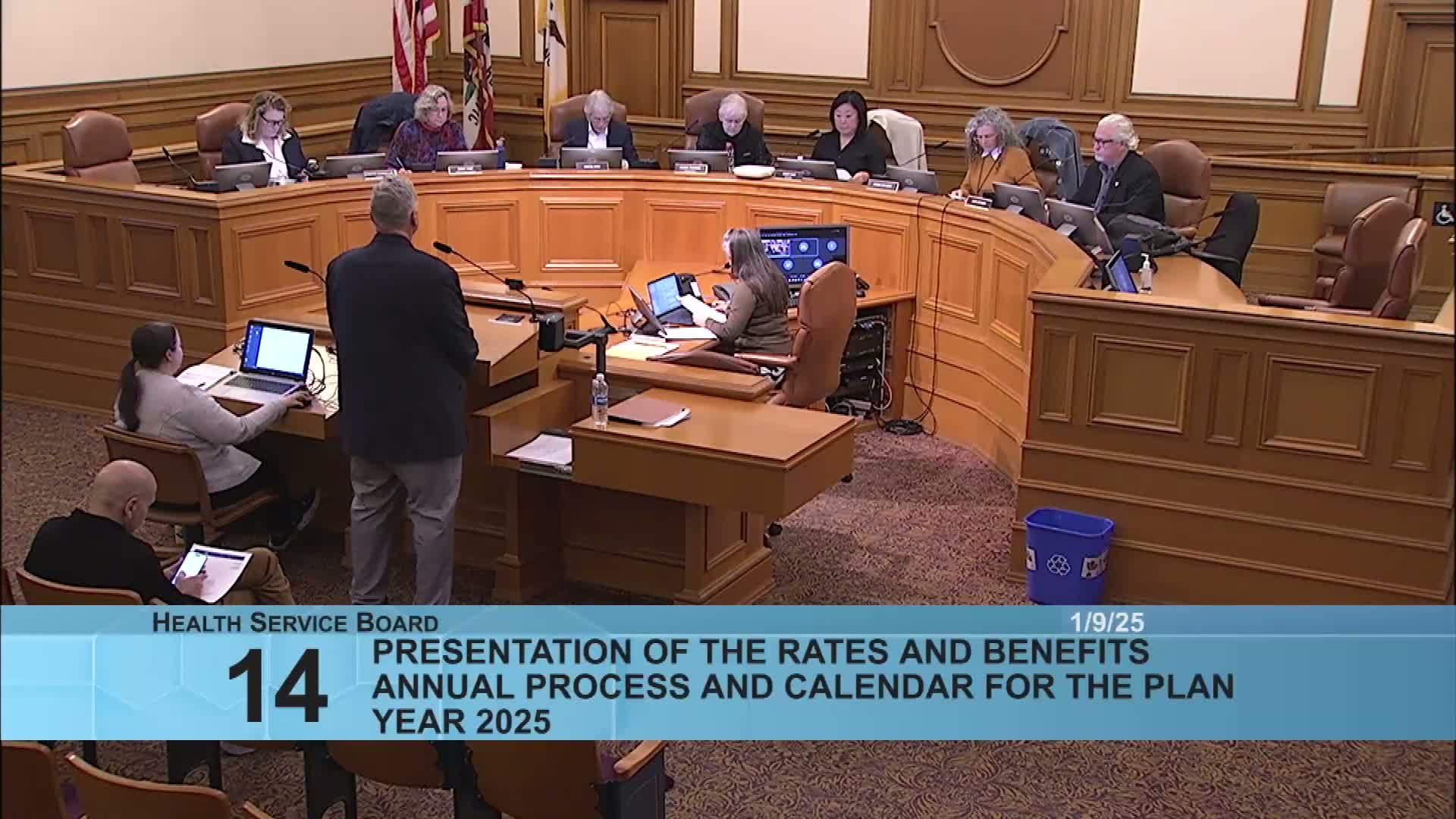
Health Service Board previews 2025 rates & benefits process, including methodology education
Summary
SFHSS and its actuary presented the annual rates and benefits calendar, explained funding approaches (self‑funded, flex‑funded, fully insured), timing for actuarial work and Board and Board of Supervisors review, and walked the board through the methodology used to project costs and translate total plan rates into employer and member contributions.
San Francisco’s Health Service Board received an overview of the 2025 rates and benefits calendar and a methodology briefing from SFHSS staff and Aon actuary Mike Clark, intended to explain how plan costs are projected, segmented and converted to employer and member contributions.
The calendar presentation outlined the annual timeline: SFHSS develops plan cost projections and reserve recommendations in the winter; the Health Service Board reviews plan cost experience, benchmarking and proposed rates in March–June; the Board of Supervisors reviews the package in July (first and second readings per city charter) and the mayor signs the final rates so open enrollment packets can be produced for mailing in September and October.
Actuarial methodology covered the five core steps used for self‑funded and flex‑funded plans: start with prior‑period claims, apply health‑care trend, adjust for plan‑design and membership changes, add administrative fees and fixed charges (capitation, MCO tax when applicable), and include SFHSS‑specific elements such as the sustainability fund charge and stabilization reserves. Clark emphasized that funding approaches differ by plan type: self‑funded plans carry claims risk into the trust; flex‑funded HMOs involve capitation and large‑claim pooling; fully insured plans (Kaiser, most dental and life/disability contracts) set fixed premiums.
The presentation reiterated how employer contributions are determined differently for active employees (guided by MOUs and fixed‑dollar or percentage formulas, e.g., $196.83 or $93.93 anchored amounts) and retirees (city charter formulas that combine a 10‑county benchmark, the actual difference between retiree and active single premiums, and a Prop E contribution that covers 50% of remaining cost for retiree only and retiree+1 tiers). Clark walked through examples showing why some retiree tiers have $0 employer contribution (when the retiree only cost is at or below the 10‑county benchmark) and how split families (mixed Medicare/non‑Medicare) are treated.
Board members asked clarifying questions about how the Prop E calculation works (Aon: it is 50% of the residual after subtracting the 10‑county and the actual difference elements) and about timing if mayoral budget directions change; staff said they were watching new mayoral guidance but would follow the schedule that allows Board of Supervisors review in July.
The board received the educational material; no action was required. Staff said the rates and benefits materials, benchmarks and a glossary will be available on the SFHSS website for commissioners and the public ahead of forthcoming rate presentations in March–June.