Get Full Government Meeting Transcripts, Videos, & Alerts Forever!
Get email alerts on the Livestock Ordinance Chickens topic
No spam. Unsubscribe anytime.
Spring Hill aldermen discuss proposal to allow more backyard hens based on lot size
Summary
Board discussion considered amending the city code to permit additional hens using a standard of one hen per 1,500 square feet of lot area, with staff support and enforcement details outlined; no vote was taken and the item will move forward for further consideration.
Board members discussed a proposed change to the city’s poultry ordinance during a work-session-style item, proposing to tie the allowable number of hens to lot size rather than a flat four-hen limit.
Alderman Fuqua said he wanted to amend city code so that property owners could have one hen per 1,500 square feet of lot area; under that formula most typical Spring Hill lots would still allow four hens, while larger lots could allow more. “For most residents in the city of Spring Hill, it does not change. It’s gonna be 4 chickens. However, those that have half acre lots, three-quarter acre, are then allowable more chickens as the space increases,” Fuqua said.
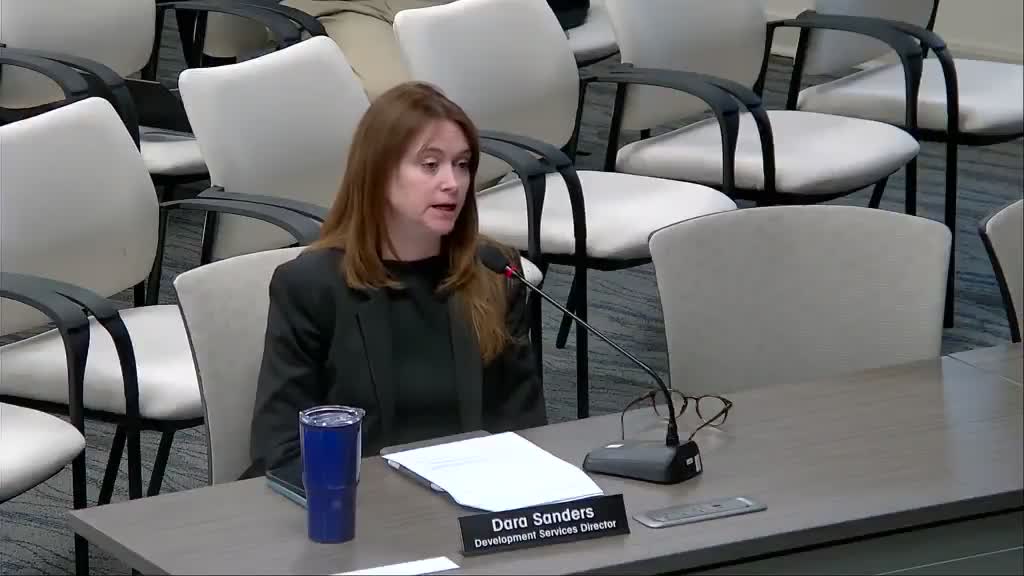
A staff member identified as Dara, development services staff, described how the calculation would work. Using a 1,500-square-foot-per-hen standard, Dara said a 10,000-square-foot lot would calculate to 6.6667 hens and the city would round down to permit six. Dara said staff supports the approach and that it is “consistent with national standards and trends.” Dara added the revision is intended to reflect Spring Hill’s agricultural roots while protecting neighbors through existing enclosure and setback requirements.
Board members raised several concerns. Alderman Davis asked about odor and neighborhood impacts; Dara replied that the code would continue to require enclosures and distance requirements, and that permitted hens are not allowed to run at large. Alderman Fuqua asked whether homeowners associations could block the city permit; Dara said HOA rules are private; even if an HOA prohibits hens, the city would still issue a permit and any HOA enforcement would be a private matter between the HOA and property owner.
On enforcement, staff described a compliance process: residents may call Development Services to request inspection; code enforcement officers would determine whether a permit holder complied with permit conditions and could revoke a permit for noncompliance. Vice Mayor Linville asked that permits be processed using recorded lot measurements rather than in-person inspections where possible, noting inspectors are already stretched thin; Dara confirmed that is the standard approach.
No formal vote was taken. Alderman Hartwell, chairing the discussion, said the item will move forward for additional consideration.
Why it matters: Changing the poultry ordinance would alter how many hens residents can keep on residential lots, affecting household food production and neighboring properties’ expectations. The discussion emphasized using measurable lot-size calculations and retaining code enforcement tools.
What’s next: Staff will prepare the ordinance language and implementation details for a future agenda, including permit procedures and enforcement provisions.