Get Full Government Meeting Transcripts, Videos, & Alerts Forever!
Get email alerts on the Urban Forestry Plantings topic
No spam. Unsubscribe anytime.
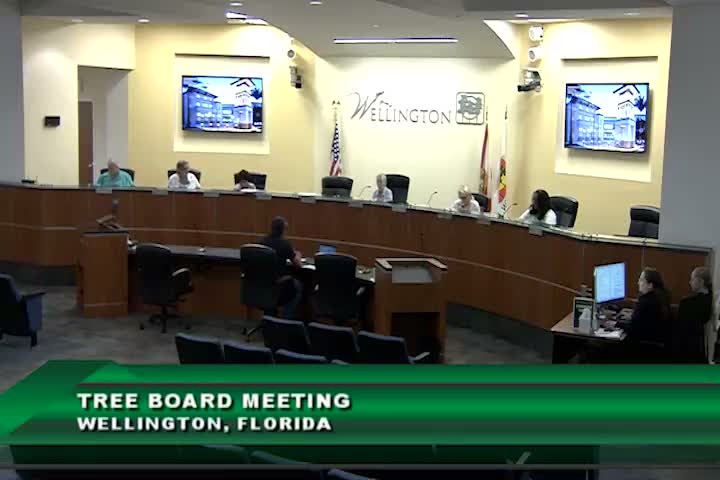
Wellington tree board: 896 trees planted this year; $50,000 agriculture grant pending for more canopy trees
Summary
Village staff told the Wellington Tree Board on June 4 that 896 trees have been planted in 2021 so far, many under Arbor Day Foundation grants, and that a pending $50,000 Department of Agriculture grant would fund roughly 138 additional canopy trees once paperwork is signed.
The Wellington Tree Board heard a staff update on June 4 that the village has planted 896 trees so far this year and plans to focus future plantings on canopy species in areas that recently received smaller stock.
Will (village staff member) told the board that recent work included multiple Arbor Day Foundation grants and three separate grant-funded plantings. “The total is now 896 for this year so far,” he said, and listed species installed during recent plantings: 32 sable palms, 29 green buttonwood, 27 satin leaf, 31 pigeon plum, 11 dense [slash] pine, 8 live oak and 6 wild tamarind. Will said some plantings included larger stock — several 45-gallon specimens and some 10–12-foot sable palms — while other material was seedlings or 1–3-gallon stock.
Board members pressed staff about survival tracking and inventories. Will said the village keeps an ongoing inventory and that crews use workdays when weather prevents other tasks to add new plantings to that inventory. He said newly planted trees carry a one-year warranty and that any tree that fails within that year will be replaced: “We have a 1 year warranty on that stuff. So if anything between now and that year…that doesn't make it, that'll be replaced.”
On larger restoration projects, Will reported that planting at the site the board referred to as Moncata (also discussed during the meeting as Mancata/Moncada plantings) is nearly complete, with final pathway and turf work remaining. He said future plantings on that property will prioritize canopy trees and that grant applications for that site will target canopy species.
Funding prospects: Will said the village is expecting an additional Department of Agriculture grant worth $50,000 that — if the paperwork is signed — would purchase roughly 138 canopy trees. “We do have another grant that's coming through the Department of Agriculture, for another $50,000 to plant more canopy trees. I don't have the signed paperwork yet,” he said.
Board members and staff also discussed removals and storm damage. Will said the village has had relatively few routine removals on public property this year but identified one scheduled removal: a royal palm at the amphitheater affected by Ganoderma. He also said the community lost about 500 trees in last year's tornado, with the largest losses at the Dumb and Douglas Preserve and other public sites; those storm losses were not counted as typical removals because they were the result of a natural disaster.
On specific species, the board discussed the municipality's Washingtonia palms. Will reported about 475 Washingtonia palms in village inventory and estimated annual trimming costs for that stretch at about $22,000–$23,000: “I spend about $22,000 to $23,000 a year just trimming those.” Board members noted the palms' height (many now 60–70 feet), maintenance limits of contractors' aerial equipment, and disease risks such as lethal bronzing.
Next steps noted in the meeting: staff will continue inventory updates, pursue the Department of Agriculture grant paperwork, and prioritize canopy-tree plantings where the board has identified gaps. Will agreed to provide photos of recent plantings for board use in outreach and reporting.
Ending — less-critical details: The board also discussed logistics such as whether the village operates its own nursery (staff said the village no longer grows stock on site), garden-club volunteer events scheduled for September, and coordination with planning and zoning on inspection of private construction landscaping to ensure compliance with the village landscape code.