Get Full Government Meeting Transcripts, Videos, & Alerts Forever!
Get email alerts on the Stormwater Management And Parking Cap topic
No spam. Unsubscribe anytime.
Norwood Commerce Center gets conservation approval with 471‑space cap and stormwater review trigger
Summary
The Conservation Commission approved an Order of Conditions for after‑the‑fact and proposed work at 61 Endicott Street (DEP 251‑0560) with a condition limiting construction to the proposed 471 parking spaces; any increase will trigger review by Norwood’s stormwater authority and may prompt a local 'loophole' pollution designation.
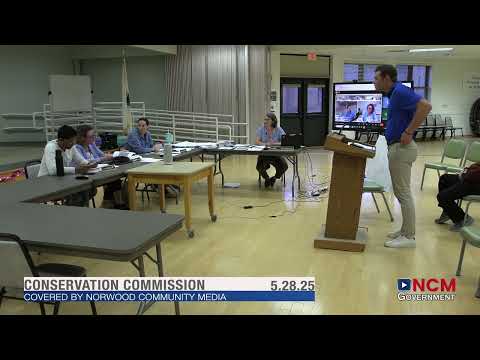
The Norwood Conservation Commission voted May 28 to approve an Order of Conditions for work at 61 Endicott Street (DEP 251‑0560, Norwood 2024‑12), a longtime industrial/commercial complex now called the Norwood Commerce Center. The approval covers a mix of after‑the‑fact paving and new improvements intended to reduce untreated stormwater flowing to Hawesbrook.
Applicant representatives described a multi‑year effort to consolidate lots, add landscape islands, repave degraded areas, remove some pavement near the riverfront, and install stormwater controls including sediment forebays, stormwater treatment units and subsurface infiltration chambers sized to capture lost recharge. Attorney David Hearn (representing ownership) and project manager Kevin Holtzer said the proposal reduces previously unpermitted pavement, adds stormwater treatment, and would provide compensatory flood storage in an area that was filled when older buildings were removed.
Peer reviewer Spencer Lins of Parr Corporation told the commission the revised design addressed earlier comments and represents “a meaningful benefit to the stormwater conditions” by adding treatment and recharge where runoff had been going untreated. Lins recommended the commission not preemptively apply Norwood’s local "loophole" designation (a local designation tied to higher pollutant loads) unless future vehicle trip generation or additional parking pushed the site into the locally defined threshold; he suggested that any future parking increase be reviewed by the town’s new stormwater authority.
After discussion about traffic counts, parking demand and the scope of mitigation, commissioners approved the project subject to several conditions: a cap that limits constructed parking to the proposed 471 spaces; a requirement that any future increase in parking trigger review by the Town of Norwood stormwater authority (including updated trip counts and local designation review); plantings and invasive‑species management (plant survival standards and a multi‑year maintenance program); and waivers for limited work in buffer and undisturbed areas where the proposed measures improve overall conditions. The vote was recorded by roll call: Kelsey Quinlan, Catherine Walsh and Anil Prasad voted in favor; Kalima Mustafa Woodburg was absent.
Why it matters: The site has decades of industrial use and multiple unpermitted paved areas that currently convey untreated runoff into a tributary of Hawesbrook. The commission’s approval ties future expansion of parking or use intensity to additional stormwater scrutiny, and it requires the applicant to install treatment that the peer reviewer and staff said will reduce pollutant loads to the waterway.
Key technical points: Commissioner and peer reviewer discussion covered groundwater table seasonality, the suitability of rain gardens versus underground infiltration given local groundwater, a seasonal "friction" adjustment to infiltration design to account for wetter periods, and provision of roughly 14,000 sq ft of compensatory flood storage in degraded riverfront areas. The applicant presented a one‑week, seven‑day traffic count showing roughly 1,355 vehicle movements in a week (average under 200 per day) and argued the site is not likely to reach the thousand‑trips‑per‑day threshold that would mandate a higher level of pollutant treatment.
Next steps: The commission’s conditions bind the project as approved; if the owner later seeks more parking or different uses that increase trip generation, the owner must return for additional review and stormwater authority analysis.