Get Full Government Meeting Transcripts, Videos, & Alerts Forever!
Get email alerts on the Wetlands Jurisdiction And Stormwater topic
No spam. Unsubscribe anytime.
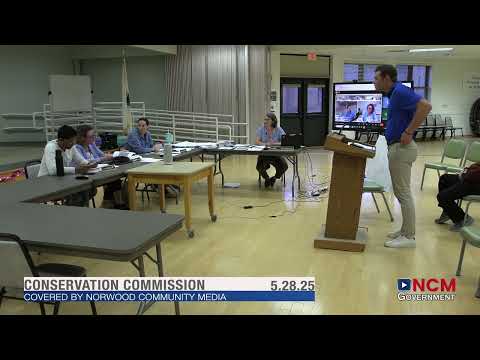
Norwood commission issues negative determination for 25 East Hoyle Street with stormwater conditions
Summary
The Norwood Conservation Commission granted a negative determination of applicability for 25 East Hoyle Street (RDA Norwood 2025-06) but attached a special condition requiring the applicant to coordinate stormwater controls with the town engineer and conservation staff following debate about whether a man-made ditch receives groundwater.
The Norwood Conservation Commission on May 28 issued a negative determination of applicability for 25 East Hoyle Street (RDA Norwood 2025-06), contingent on special conditions requiring on-site stormwater management and coordination with the town engineering department and the commission’s agent.
The applicant, represented in the hearing by Morgan Bloom of Panther Residential and consultant Tom Schutz of Gauter Consulting, sought confirmation that a ditch along the western and southern edge of the 2.5-acre site is non-jurisdictional under the Massachusetts Wetlands Protection Act and the Town of Norwood Wetland Bylaw. Schutz presented the town’s drainage studies (2004, updated 2020) and argued the ditch conveys only stormwater discharged from a municipal pipe network and an on-site infiltration system at Norwood Hospital.
Commissioners questioned whether the ditch also receives groundwater. Commissioner Catherine Walsh said, “I went out today, and it was running,” and expressed concern that observed flow after a major rain event could reflect groundwater or prolonged release from infiltration chambers. Schutz replied the town’s drainage report traces the flows to the piped system and that, in his view, the ditch “is serving only to convey stormwater and is not jurisdictional under the Wetlands Protection Act or the Norwood Wetland bylaw.”
After discussion about options — declaring the waterway jurisdictional, issuing a negative determination, or continuing to gather hydrologic data — the commission moved to grant a negative determination while adding a condition that the applicant work with the town engineer and the conservation agent to design and implement appropriate stormwater controls to protect downstream resources. The motion passed on a roll call: Kelsey Quinlan, Catherine Walsh and Anil Prasad voted in favor; Kalima Mustafa Woodburg was absent.
Why it matters: The determination affects what protections and permitting a future redevelopment of the paved, formerly gravel lot will require. If the waterway were deemed jurisdictional under the bylaws or Wetlands Protection Act, the applicant would face more stringent riverfront and buffer-area standards; with the negative determination plus conditions, the commission sought to reduce downstream risk while avoiding a determination that would automatically trigger a Notice of Intent.
Next steps: The applicant accepted the condition and will coordinate stormwater design with the town engineering department, which becomes the town’s stormwater authority as of the following day. The commission noted it can revisit jurisdiction or require an NOI if new evidence shows the feature is fed by groundwater or otherwise qualifies as a resource area.