Get Full Government Meeting Transcripts, Videos, & Alerts Forever!
Get email alerts on the Airport Safety Wildlife topic
No spam. Unsubscribe anytime.
Commission amends airport wildlife-fencing order after FAA consultation; further beaver/wildlife issues discussed
Summary
The Conservation Commission amended a previously issued order of conditions for wildlife fencing at Norwood Airport to reflect FAA-required realignment; commissioners also discussed ongoing beaver activity and ponding on airport property but did not authorize funding for beaver control.
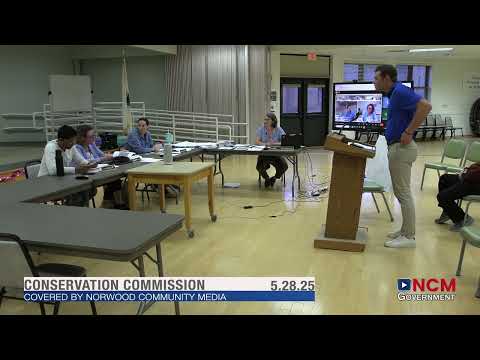
Norwood’s Conservation Commission on May 28 amended an earlier order of conditions for a wildlife fence at Norwood Airport to reflect alignment changes required by the Federal Aviation Administration, and commissioners discussed separate but related concerns about beaver dams and ponding near a runway safety area.
Consultant Alyssa Jacobs of Epsilon Associates told the commission that after consultation with the FAA the fence must remain in or near its existing alignment to maintain approach sight lines and runway visibility zones. Jacobs said the revised plans pull some fence portions out of adjacent wetlands where feasible but otherwise keep the new fence in substantially the same corridor because FAA safety and approach-lighting considerations limit how close the fence can be to the airfield.
The commission voted to amend the order of conditions to reflect that alignment. The amendment was procedural in nature: it adjusts the authorized fence alignment to meet federal safety requirements while minimizing wetland impacts where possible.
Separately, airport staff and commission members held a detailed discussion about beaver activity near the taxiway and runway. Airport manager Mark Raven explained that beavers have constructed a lodge and a small dam that has created ponded water adjacent to recently repaved runway infrastructure. Raven said the ponded water raises concern because it can attract waterfowl — a known hazard to aircraft — and because high water levels could affect runway safety-area standards established by the FAA and MassDOT. He also noted that runway repaving has been a recent, costly project and that maintaining runway safety areas is part of grant assurances tied to federal funding.
Commissioners discussed management options: trapping (which may require board-of-health authorization and is often a permanent removal method), installation of water-flow devices that control pond height, and nonlethal repellents such as flagging. Commission staff reported outreach to private beaver-management firms; some firms were not immediately available, and one consultant warned that flow devices may slow but not eliminate ponding because beavers frequently rebuild. Several commissioners said the airport should coordinate with state or regional aviation environmental staff who have handled similar problems at other airports.
The commission did not authorize funding or a specific intervention. Commissioners expressed sympathy for the airport’s safety and infrastructure concerns, said the commission would support any properly permitted work, but also indicated the commission is not prepared to fund airport mitigation. The commission noted that it would have jurisdiction and permit-review authority if the airport proposed physical work in jurisdictional wetlands (for example, installation of a flow device or dam removal), at which point the commission would review and could issue the required permits.
What’s next: the commission amended the fence order to match FAA guidance. Airport staff will pursue options for beaver management and were advised to consult the town engineer, Massport/FAA environmental contacts or other regional experts before proposing regulated work for commission review.