Get Full Government Meeting Transcripts, Videos, & Alerts Forever!
Get email alerts on the Signs topic
No spam. Unsubscribe anytime.
Planning commission narrows approach to sign rules: 60-day temporary limit, consider percentage-based allowances
Summary
After extended review of draft definitions and temporary-sign rules, the Planning and Zoning Commission directed staff to rework the signage ordinance using percentage-based sign allowances, discussed a 60-calendar-day limit for temporary signs, and suggested limits on balloon signs and permitting for certain sidewalk signs.
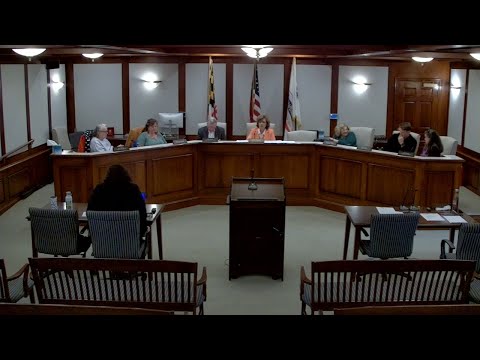
Chesapeake Beach planning commissioners spent the bulk of their May 28 meeting reviewing a broad redraft of the town's signage ordinance definitions and temporary-sign rules and directed staff to return with a revised format that emphasizes sign-type allowances and percentage-based size limits.
Planner Sarah Franklin said the draft had been reorganized to place definitions at the front and consolidate content-based rules. Commissioners worked line by line through definitions such as "alteration," "abandoned sign," "animated sign" and a long list of specialized sign types (balloon, banner, sandwich board/A-frame, changeable copy, electronic message center). Franklin and commissioners agreed that the definitions should be tightened and that unused definitions could be removed after the ordinance text was consolidated.
Temporary signs prompted extensive debate. Commissioners discussed whether a short fixed time limit or a per-year total would work best. Several commissioners proposed 30 or 45 days; others favored a longer allowance to cover holiday displays. Planner Franklin suggested a time limit "60 calendar days in a year." That phrasing was cited in the discussion as a working proposal for how to allow holiday and event signage without creating a route for perpetual temporary displays.
On permitting, the commission leaned away from a universal temporary-sign permit because of limited staff capacity. Instead commissioners generally favored allowing many temporary signs without permits unless the town observed abuse; they specifically discussed permitting higher-risk items (for example, tethered or large balloons) or sidewalk sandwich/A-frame signs to address safety concerns. The commission voiced support for language requiring A-frame signs to be properly secured or weighted and to be removed or stored when the business is closed or during high-wind events.
Commissioners also discussed moving away from many content-based temporary categories ("sale sign," "event sign," etc.) in favor of regulating the physical sign types (banner, window sign, sandwich board, feather sign) and applying size rules by percentage of building frontage or similar metric. Several commissioners suggested an approach that sets an overall allowable amount of sign area per business (for example, a permanent allowance plus a small percentage allowance for temporary signage) so businesses can allocate that area among banners, window signs and portable signs.
There was a clear leaning toward prohibiting large tethered "balloon" signs and toward not requiring permits for most temporary signs, with exceptions for safety-sensitive sign types. Franklin said she will reorganize the draft ordinance to present: 1) a concise list of sign types, 2) percentage-based coverage options for permanent and temporary signs, 3) specific conditions for sandwich/A-frame signs (weights, hours of display), and 4) a short prohibited-exempt list. Commissioners asked staff to return with a condensed draft for further review.