Get Full Government Meeting Transcripts, Videos, & Alerts Forever!
Get email alerts on the Ethics Commission Audit topic
No spam. Unsubscribe anytime.
City auditor recommends changes to Sacramento Ethics Commission operations; council approves audit work plan
Summary
City Auditor Farishta Rari presented an audit identifying five findings and 11 recommendations to strengthen the Ethics Commissions training, complaint intake, staffing and contract practices; the council voted unanimously to approve the audit work plan.
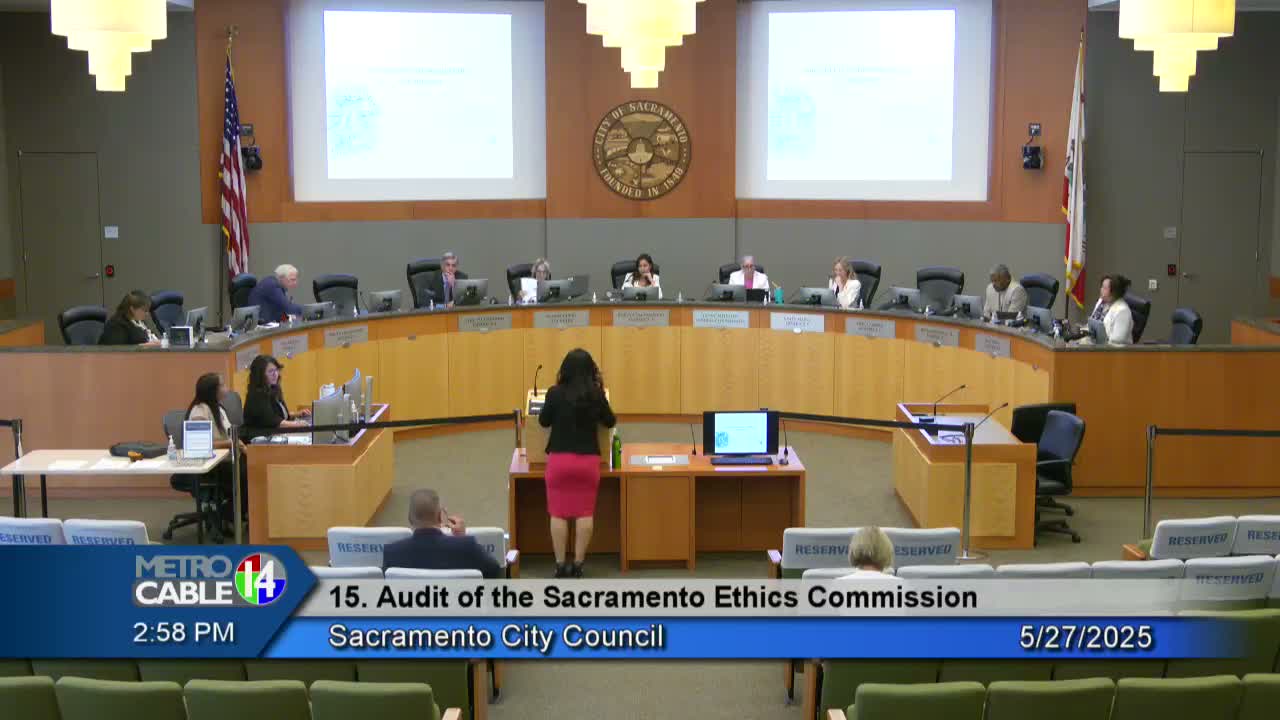
City Auditor Farishta Rari presented an audit of the Sacramento Ethics Commission to the City Council on May 27, 2025, outlining five findings and 11 recommendations intended to strengthen the city's good governance program, improve training and guidance, and formalize complaint intake and staffing procedures.
Rari summarized the commission's establishment in 2018 as part of a good-governance framework that included a Sunshine Ordinance, a code of ethics and an ethics commission empowered to review and adjudicate complaints alleging violations of city ethics laws. The audit found opportunities to improve strategic planning, commissioner training and public guidance, and recommended automating complaint intake, improving recordkeeping and explanations for complaint dismissals, clarifying procedures for staff support and work plans submitted to the Personnel and Public Engagement (PNP) committee, and revisiting the city's prior contract with the California Fair Political Practices Commission (FPPC).
Specific audit findings included that the commission and staff should: conduct strategic planning to document objectives and monitoring; provide additional onboarding and ongoing training for commissioners on campaign, lobbying and ethics laws; create public-facing guidance and consider a formal advice function; automate and better control complaint intake and ensure anonymization on public complaint logs when required; and better document rationales when complaints are dismissed for lack of jurisdiction. The audit also noted the city had a contract with the FPPC that expired in December 2019 (negotiations did not result in renewal, in part over a disputed $55,000 contract-floor amount), and that the services FPPC previously provided have since been performed by the city clerk's office and the independent evaluator.
Councilmember Dickinson, who had discussed the audit at the Budget and Audit Committee, emphasized concerns raised by the commission's chair and vice chair about the commission's perceived independence when it lacks dedicated staffing and resources that independent commissions in other cities often have. The city clerks office concurred with most of the auditors recommendations, and Rari noted management responses from the clerk and the commission were included with the audit.
The council voted unanimously to approve the audit work plan and receive the auditor's recommendations; the motion passed on a voice vote. Councilmembers discussed that next steps should include defining training curriculum, estimating staffing needs as part of commission work plans to the PNP committee, and clarifying the commission's authority to review contracts with outside agencies such as the FPPC.
Rari closed by thanking the city clerk's office, the ethics commission and the city attorney's office for their assistance during the audit; no public commenters spoke on the item.