Lifetime Citizen Portal Access — AI Briefings, Alerts & Unlimited Follows
Sacramento receives AB 2561 vacancy report; firefighters warn of brownouts and chronic overtime
Loading...
Summary
Human Resources presented the citys AB 2561-required 2024 vacancy and recruitment report; Sacramento Area Firefighters Local 522 described daily staffing shortfalls, mandatory overtime, and repeated station closures in 2024. Council directed staff to continue integrating vacancy review into the budget process; the public hearing was opened, closed
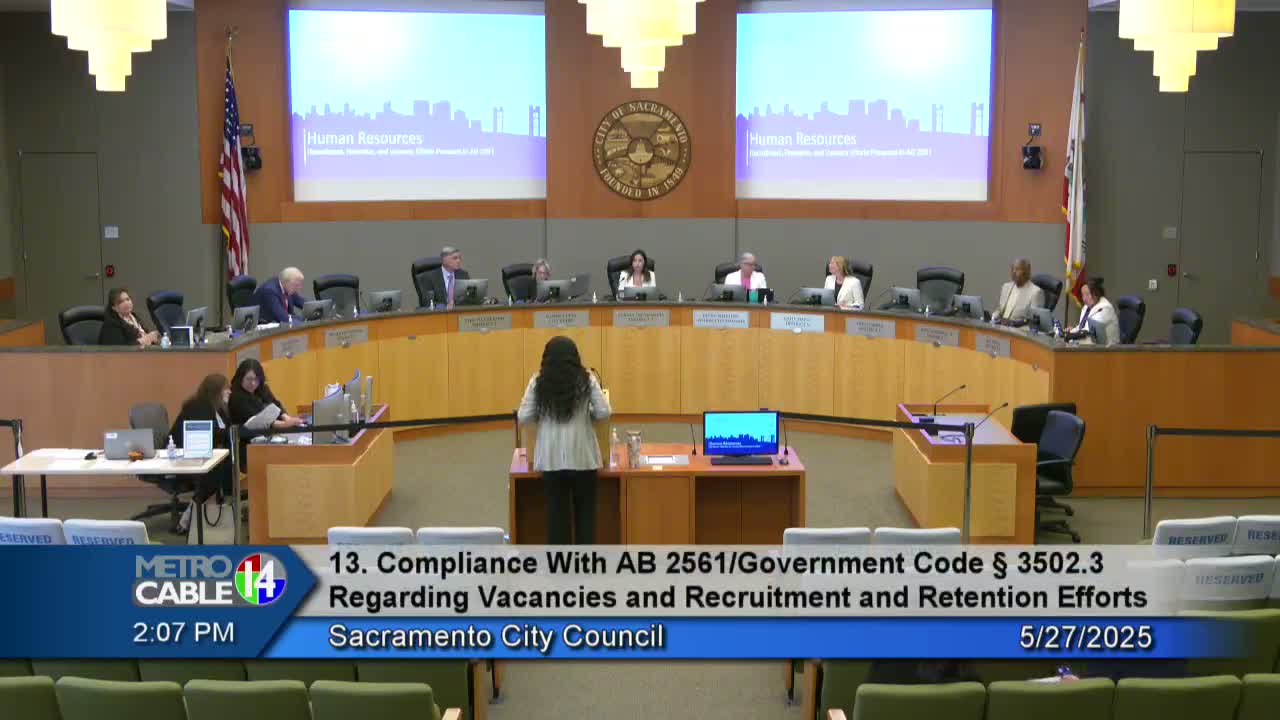
Sacramento City Council on May 27, 2025 heard a required presentation under Assembly Bill 2561 on the citys 2024 vacancies, recruitment and retention efforts, and received testimony from Sacramento Area Firefighters Local 522 about staffing shortfalls that led to frequent engine and company closures last year.
The report, presented by Ebony Heaven, human resources manager for the Employment Classification and Development Division, summarized AB 2561's requirement that public agencies publicly report on staffing vacancies, recruitment efforts and retention strategies before adopting their annual budgets. The citywide vacancy rate for 2024 reported in the presentation was 18 percent; full-time represented positions had a 14 percent vacancy rate, while part-time and seasonal roles showed substantially higher, variable rates. Heaven described data limitations in the city's applicant-tracking system (NEOGOV) and outlined recruitment and retention steps including blind applications, DEI-informed outreach, an upcoming onboarding tool in NEOGOV, flexible work options, and vendor-supported national recruitments.
The presentation also included unit-level detail: the traffic engineering unit (job series represented by Local 1176) has 16 budgeted positions and, as of May 27, 2025, 4 current vacancies (about 25 percent, down from 44 percent in 2024). The automotive and equipment mechanics unit represented by IAMAW has 69 budgeted positions and 14 current vacancies (about 20 percent). The city reported an average time-to-hire metric (from posting to hire) that reflects many process-dependent factors, including civil-service examinations and continuous postings; Heaven said the citys cutoff for the report was Dec. 31, 2024 so year-to-date figures were provided in narrative during the meeting.
Ryan Henry, vice president of Sacramento Area Firefighters Local 522 and a fire captain with the Sacramento Fire Department, told the council that vacancies in suppression and emergency medical services directly affect public safety. He said each engine or truck is staffed with four personnel, the department operates 34 fire companies out of 24 stations and staffs 18 ambulances with two firefighters each, and that the daily staffing need for suppression and ambulance companies is 71 personnel. Henry said the department averaged 23 vacancies per day in the recent period, and that in 2024 the city closed companies (so-called brownouts) 152 times. He described the departments three vacancy-filling mechanisms—hiring (which can take up to 13 months), a detail pool, and mandatory overtime—and said the current detail pool is far too small (12 detail-pool firefighters per shift; 37 total) and the detail pool would need roughly 102 additional firefighters to significantly reduce mandatory overtime. Henry urged reinstating two fire academies per year, expanding the single-role ambulance program, and exploring public-private partnerships for ambulance transport to relieve staffing strain.
During public comment, Barbara Ram suggested extending blind processes to interviews and proposed testing smaller crew sizes or limiting fire engine responses to certain calls; her suggestions were recorded but not acted on during the meeting.
Several council members asked follow-up questions about the retention calculation and about using vacancy reviews as a budgeting tool. Councilmember Dickinson questioned the retention-rate math; Heaven explained the city calculates retention by tracking the cohort of regular full-time employees on Jan. 1 and measuring how many of those same employees remained employed on Dec. 31 of the same year (2024 retention 92% by that method; year-to-date 2025 retention 98% as of May 27, 2025). Councilmembers Plegambam and Vang asked about benchmarking against other cities and about departmental authority to reclassify or eliminate positions; the interim city manager and Heaven explained departments work with HR year-round and make formal recommendations in the budget process.
The council opened and closed the public hearing on the vacancy report and moved the item; the motion passed unanimously.
Councilmembers indicated they want continued data-building, more refined benchmarking, and a plan to incorporate vacancy-review analysis into next years budget development. City staff said they will provide ongoing recruitment metrics, continue DEI-informed hiring practices, and pursue technical improvements to NEOGOV reporting and the onboarding tool.