Get Full Government Meeting Transcripts, Videos, & Alerts Forever!
Get email alerts on the Compensation And Budget topic
No spam. Unsubscribe anytime.
Pueblo West Metro District board directs staff to carry 2025 budget forward, study hybrid pay options for 2026
Summary
After a detailed review of a new compensation-ratio rubric, the Pueblo West Metro District board directed staff to carry the 2025 budget forward with a 2.2% COLA and approved new positions, to survey employees, and to study a hybrid merit/objective pay model before finalizing the 2026 budget.
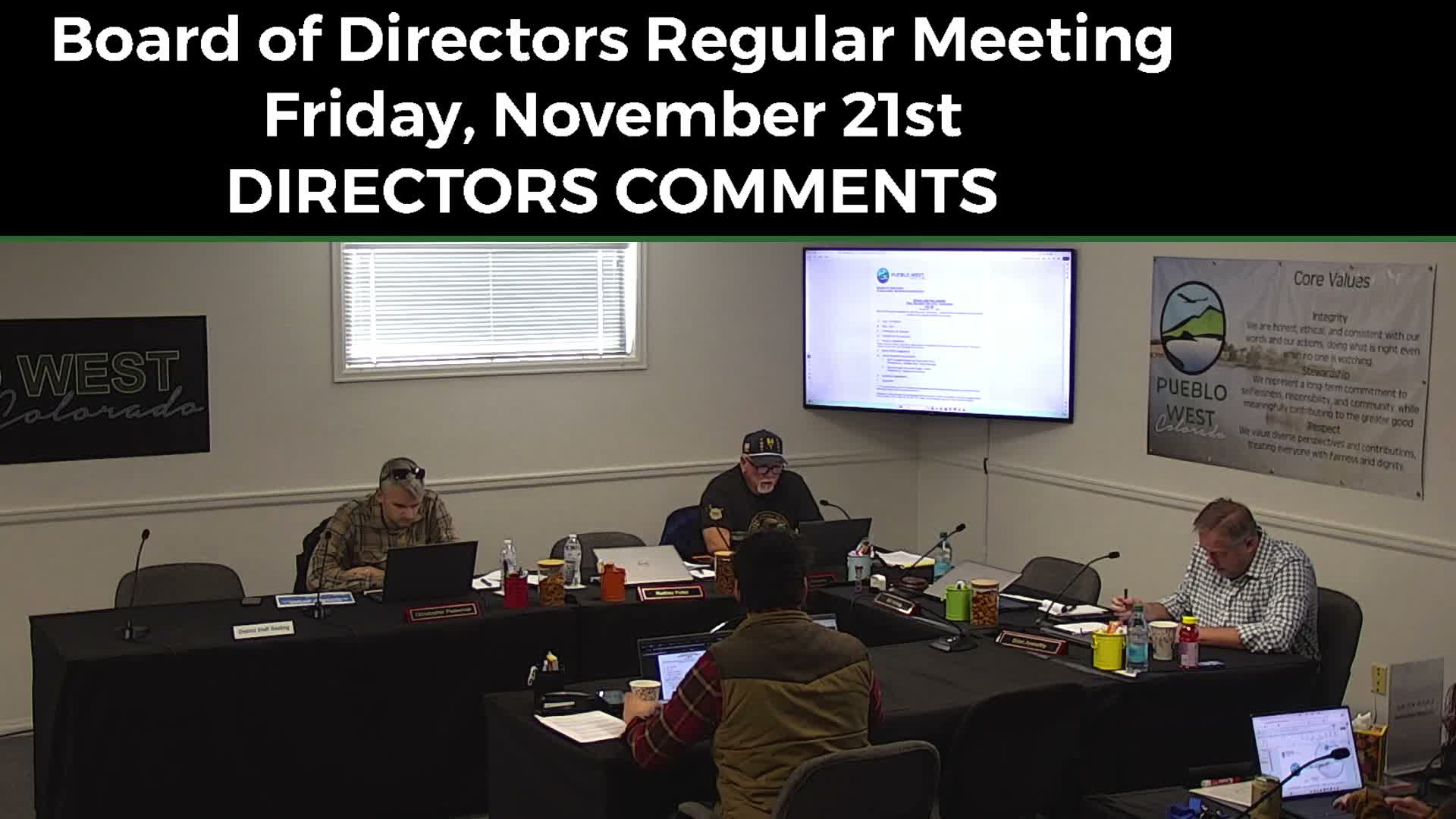
PUEBLO WEST — The Pueblo West Metro District Board spent the bulk of a Nov. 21 special meeting examining a newly adopted compensation-ratio rubric that ties pay to objective factors such as education, certifications and longevity and reporting its budget implications for 2026.
District manager Christian J. Heine led the presentation and told the board the rubric separates the evaluation template from the pay range: the compensation range uses a 0.8 minimum, 1.0 midpoint and 1.2 maximum for each position. He said certifications, education and longevity are scored and capped to limit rapid budget increases and that certifications approved by a department head and HR typically trigger a payroll adjustment at the next cycle and may be backdated to the submission date.
Board members raised repeated concerns that certification-driven increases could reward employees who do not use the newly certified skills on the job. Director Pasternak and others recommended supervisory checks (for example a six-month utilization review), guidance about which certifications the district will fund, and examples showing how the rubric would move a new hire, a 10-year employee and a 20-year employee through the range.
Heine said the district’s average comp ratio moved to about 0.96 in the year under review, and that the initial direct-cost modeling of the rubric had shown roughly $100,000 in additional annual expense in the scenario presented. He also cited a turnover-cost analysis using a standard SHRM approach that produced a larger soft-cost figure in an analysis shared with the board for context.
Rather than approving the higher projection shown in the published budget book, board members said they preferred a more conservative near-term path. The governing body gave staff direction to carry forward the 2025 budget level, add a 2.2% cost-of-living adjustment and the new positions already authorized, and to hold further CR rubric changes for additional review. The board also asked staff to provide: (a) redacted example rubrics and per-position calculations, (b) anonymized Rubik/Rubrik evaluation entries or representative examples, (c) exit-interview summaries explaining reasons people leave, and (d) an all-employee survey about perceptions of the compensation changes and a department-head review. Staff were asked to aim for a high response rate and to return with materials ahead of final budget action in December.
Board members also instructed staff to explore hybrid options that retain objective scoring for education, experience and longevity while adding a limited performance or supervisory-evaluation component — or a year-end bonus mechanism — to recognize unusually strong performance without entrenching it into base pay immediately.
The board did not take a formal vote on changing the CR rubric in the meeting; it approved the administrative direction described above and requested concrete examples and staff analysis to inform any later amendments. The board also asked staff to provide the exact employee counts affected by the March implementation and to produce clear line-item examples showing the difference between the scenario carried forward and the higher projection in the budget book.
The meeting record shows the board approved the meeting agenda at the start of the session and adjourned at the end of the session. Staff said the proposed CR rubric was implemented earlier in the year and will be further analyzed through the winter if the board decides changes are needed.