Get Full Government Meeting Transcripts, Videos, & Alerts Forever!
Get email alerts on the Budget Water Rates topic
No spam. Unsubscribe anytime.
Pueblo West board hears proposed 2026 budget and a plan to raise water bills 15%
Summary
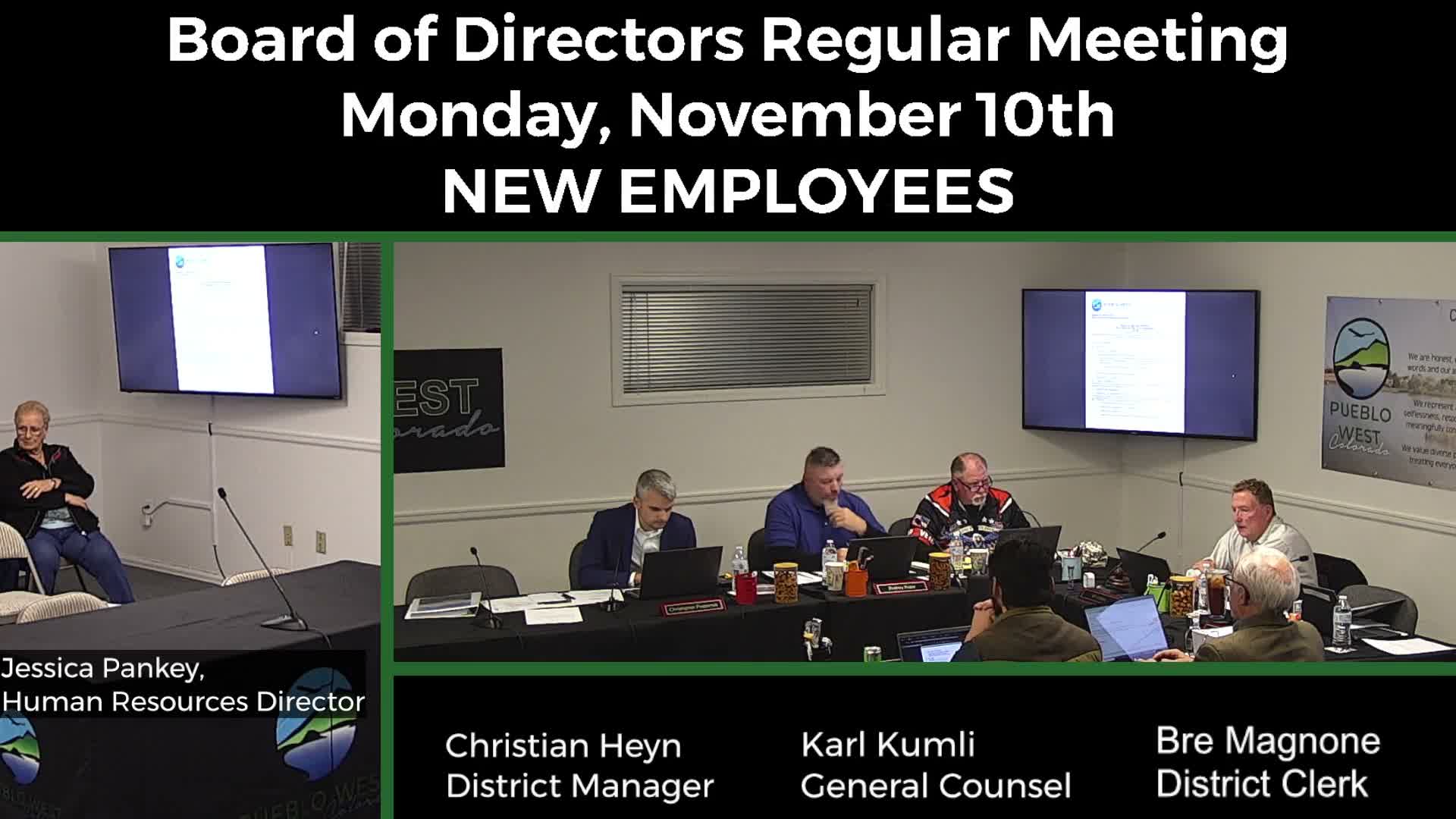
At a Nov. 10 Pueblo West Metropolitan District meeting, staff presented the proposed 2026 budget and a concurrent rate study that would raise residential water charges about 15% and wastewater about 5%, citing rising treatment, power and capital costs. Directors pressed staff for more detail on salary projections and cost allocations before a final vote.
Pueblo West Metropolitan District board members spent much of their Nov. 10 meeting reviewing staff changes to the proposed 2026 budget and hearing a separate public rate hearing in which utilities staff proposed a 15% increase to water charges and a 5% wastewater increase. The proposed water changes would include a new fourth consumption tier and higher connection fees; staff said the package would generate roughly $3 million in additional revenue and called for an effective date of Jan. 1.
Finance director Karen Cordova told the board staff corrected an administrative error that had swapped two salary line items and then outlined $36,098 in additional general-fund expenditures tied to capital-policy implementation, advertising and a position swap between a stormwater inspector and a project manager. Cordova said the utilities department asked staff to add connection-fee revenue that had not been captured in the initial draft: "[W]e increase the water fund by 4,595,000 and increase the waste water fund 435,000," she said.
At a separate presentation, Director of Utilities Jim Blasing said the recommendation responds to rising costs for chemicals, power and regulatory compliance — "we're proposing a 15% with water and a 5% with wastewater." Blasing and deputy director Jeffrey Herrera said the district faces aging infrastructure and a multi-year capital plan that will require greater revenue to support replacement and, where needed, bonding.
Public commenters and several directors questioned how personnel costs and internal accounting can affect rates. Former board member Joe Mahaney urged greater transparency in monthly invoicing between the metro district and the water enterprise, saying the pattern "appears to be a way to pad the budget." Staff responded that the invoicing is an internal accountability mechanism and that when the water enterprise uses its own metered water the entries result in offsetting revenue and expense (a net zero) but acknowledged the presentation could be clarified.
District manager Christian High and finance staff spent substantial time explaining the proposed compensation changes. High said much of the larger salary projection in the draft budget reflected a conservative compensation-ratio buffer that staff now plan to reduce; he emphasized that the only guaranteed pay change currently proposed is a 2.2% cost-of-living adjustment and that the higher projected figure had been intended as a contingency. "They're essentially paying themselves," one board member summarized the circularity that concerned some members; staff said they would provide clearer journal-entry examples and historical invoices.
Board members asked staff for concrete, historical detail before any final approval: requests included year-by-year records of rate filings, an itemized history of chemical and electricity invoices back to 2022, and a line-item breakdown showing how much of specific positions is charged to water/wastewater funds. Staff committed to providing that information in advance of the next meeting and to re-run salary projections after lowering the compensation-ratio estimate.
Staff said an estimated ending fund balance for the water enterprise was roughly $3.59 million and that the proposed readiness and consumption fee adjustments would produce modest recurring revenue; staff also noted connection-fee increases are part of the package to shift some capital burden toward growth. The utilities presentation included model customers showing a typical monthly increase most customers would see to a baseline of about $66.40 for water and $9.52 for sewer under the proposal.
Next steps: staff will deliver the requested historical invoices and revised salary projections to the board ahead of a subsequent meeting. The board set a tentative timeline to reconvene and asked staff to return with the updated figures before any final adoption vote.