Adviser recommends $40.5 million bond package for Heath water-bridge plan; board to ask council for notice of intent
Loading...
Summary
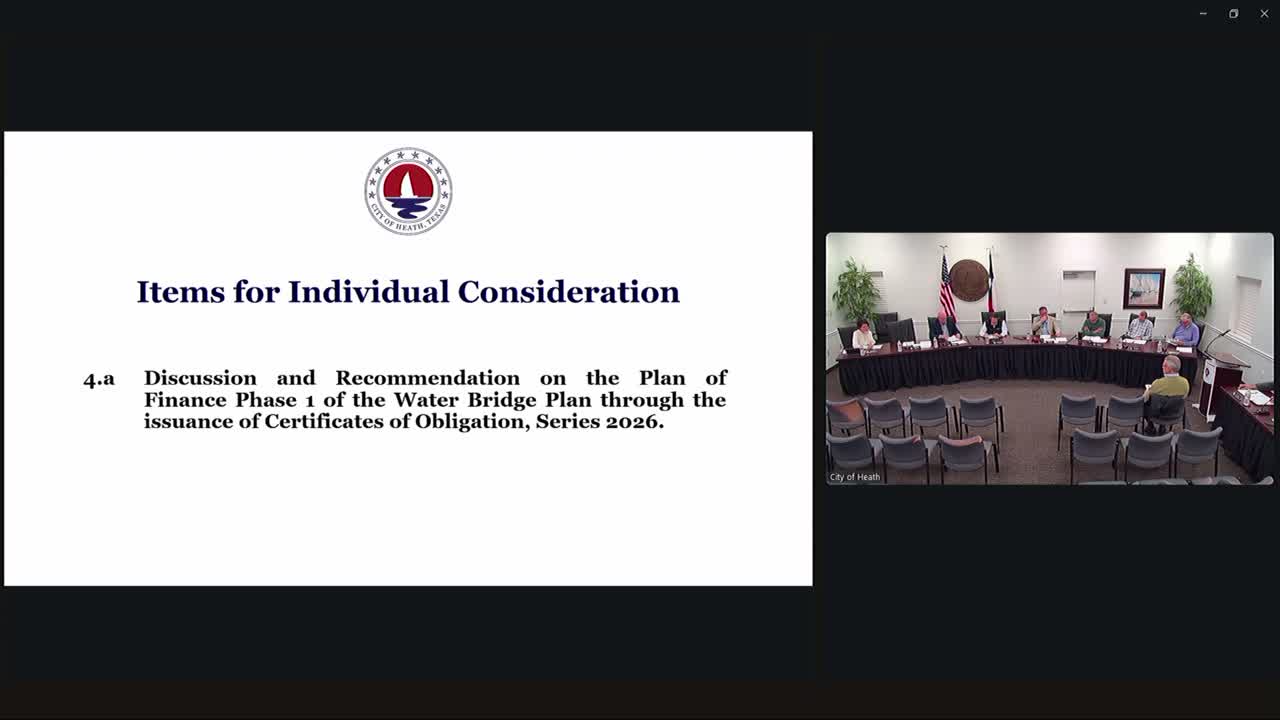
At a Finance Board meeting, Hilltop Securities advised a $40.5 million financing package for Heath’s water-bridge program, recommending a Texas 'double-barrel' pledge using utility revenues to avoid raising ad valorem taxes; the board signaled it was comfortable asking the city council to publish a notice of intent to issue up to $40 million, subject to further review of call features and phasing.
The Heath Finance Board heard a plan to finance the city’s water-bridge capital program with roughly $40.5 million in bonds, a Hilltop Securities managing director told the board.
"What we're here to talk about is funding 40,500,000.0 of funds for your water bridge plan," Jim Sabonis said, describing a structure that would combine an ad valorem pledge with net utility revenues — a so-called Texas "double barrel" pledge — to preserve Heath’s high credit rating while limiting pressure on property tax rates.
Sabonis walked the board through tradeoffs in amortization, call features and refunding. He said shortening the schedule from 25 to 20 years would reduce aggregate principal-and-interest from roughly $73 million to about $65 million — a lifetime savings Sabonis estimated at about $8.3 million — at the cost of about $70,000 more per year in debt service.
On refunding existing callable bonds, Sabonis described expected gross savings of approximately $157,000 and characterized that result as an "inefficient refunding," saying it would likely not justify losing structural flexibility.
He also reviewed call-feature alternatives and timing: shorter call windows raise near-term costs but can provide future refinancing flexibility. Sabonis offered to produce additional scenarios targeted at a 5% present-value savings threshold and recommended the board defer specific call-feature decisions until pricing specifications are prepared two weeks before sale.
Sabonis outlined the anticipated schedule for the transaction: a published notice of intent (two publications as required), a pricing in March, a potential sale on March 24 and closing in late April; he emphasized the notice is a "not to exceed" authorization and projects may be removed before sale.
City staff described project-level needs that the bonds would fund: an elevated storage tank estimated at about $13.8–14.5 million, a shared 3,000,000-gallon ground storage tank (split with the City of Rockwall), reimbursement of $1 million for Well No.1 (a $5.5 million project) and the design and expected bidding schedule for wells 2–4 (estimated about $6.6 million apiece). Staff said the elevated and ground tanks are roughly 60% through design and that some well awards could be pushed into 2027 depending on logistics.
After questions, city staff summarized next steps and the board indicated it was comfortable moving forward for the city council to issue a notice of intent to issue up to $40,000,000 for phase 1, provided the board receives additional analysis on call features and that any projects pushed to later phases be considered in the final decision. The Finance Board is not a voting body; the city council has final authority on bond issuance and structure.
The board directed staff and the financial adviser to provide additional analyses on call-feature breakpoints and to return with updated amortization and two-phase-issuance scenarios before the council takes final action.