Get Full Government Meeting Transcripts, Videos, & Alerts Forever!
Get email alerts on the Alternative Landscape Plan topic
No spam. Unsubscribe anytime.
Staff proposes Alternative Landscape Plan to address irrigation, soil and groundwater limits
Summary
Staff proposed an Alternative Landscape Plan (ALP) to provide predictable, site-appropriate alternatives where irrigation is unavailable, soils are too saline (staff cited a ~16 millimoles salinity threshold), or high groundwater prevents plant establishment; commissioners favored a narrow, performance-based approach and asked staff to draft code language and point-menu examples (Avon model) for the hearing.
City planning staff introduced an Alternative Landscape Plan (ALP) intended to address recurring situations where existing landscape standards cannot be met because irrigation taps are unavailable, soils are too saline or alkaline, or high groundwater prevents healthy plant growth.
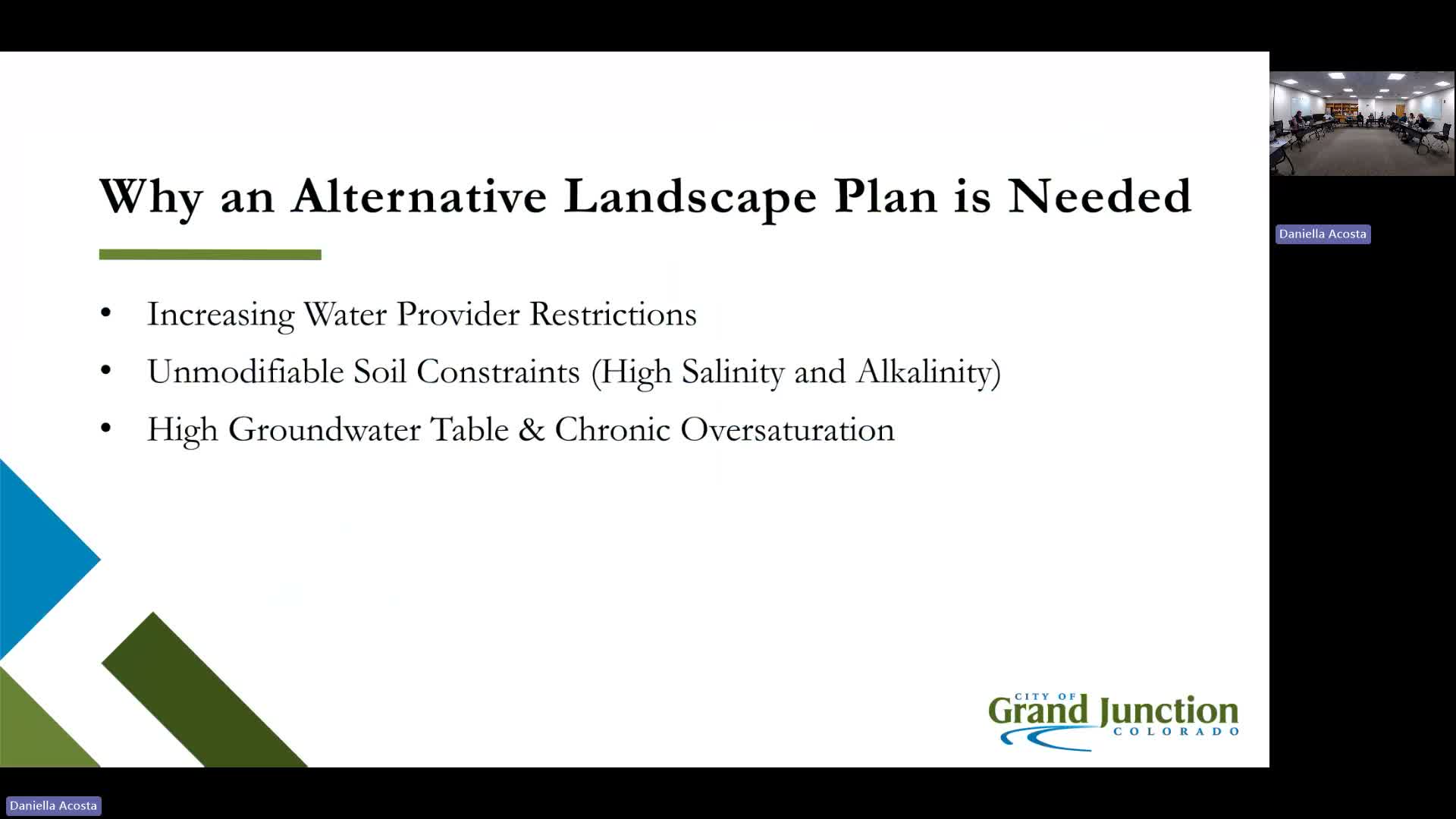
Staff described three common constraints: water-provider restrictions (they cited Butte Water as an example that may deny irrigation taps), soil conditions with salinity above roughly 16 millimoles that cannot be economically amended, and shallow groundwater that causes chronic oversaturation and root failure. Staff said the current code lacks a structured, administratively efficient pathway other than case-by-case variances and that an ALP would create predictable, defensible alternatives for such sites.
Two broad ALP structures were discussed. A discretionary model would allow landscape architects to propose custom designs evaluated through professional judgment; it is flexible and can encourage innovation but produces slower reviews and higher appeal risk. A prescriptive performance-based model would create a menu or point system (staff pointed to the Town of Avon example) where vegetation, hardscape and other elements have assigned values and an applicant meets a required number of landscape units for their frontage.
"Anything over 16 millimoles in terms of salinity really just can't be amended," staff said when describing the soil threshold discussed in the workshop. Commissioners agreed ALP eligibility should be narrowly defined and tied to documented constraints (soil analysis, geotechnical reports, or water-provider documentation). Several commissioners urged that the ALP preserve core landscape functions — stormwater management, shading and buffering — rather than becoming a route to eliminate landscape intent entirely.
The Avon menu example shown by staff assigns landscape units by frontage (one landscape unit per 50 feet) and gives higher points for preserved mature canopy than for newly planted materials; the menu also assigns values to hardscape items, boulders and other nonvegetative elements so applicants can mix and match while still meeting predictable outcomes. Commissioners cautioned that point systems can be gamed or lead to repetitive solutions; staff said those risks can be mitigated in code calibration and by limiting eligibility to verified constraints.
Commissioners directed staff to draft a performance-based ALP framework with narrow eligibility criteria, clustering options where soils permit, preservation incentives, and clear verification steps for appeals. Staff will prepare draft code language and examples for the next workshop or the public hearing so the commission can evaluate specific menu values and administrative processes.