Get Full Government Meeting Transcripts, Videos, & Alerts Forever!
Get email alerts on the Parks Impact Fees topic
No spam. Unsubscribe anytime.
Council workshops parks impact-fee options; staff recommends trimming outliers (Option 3), first reading proposed Jan. 7
Summary
City staff and consultants presented three alternatives for calculating parks impact fees (baseline weighted land value ~$147,000/acre; options remove downtown parcels, central-city parcels or high/low outliers). Staff recommended Option 3 (remove outliers); council indicated informal consensus and staff scheduled a first reading for a fee ordinance on Jan. 7 with possible rebate language for applications in the pendency period.
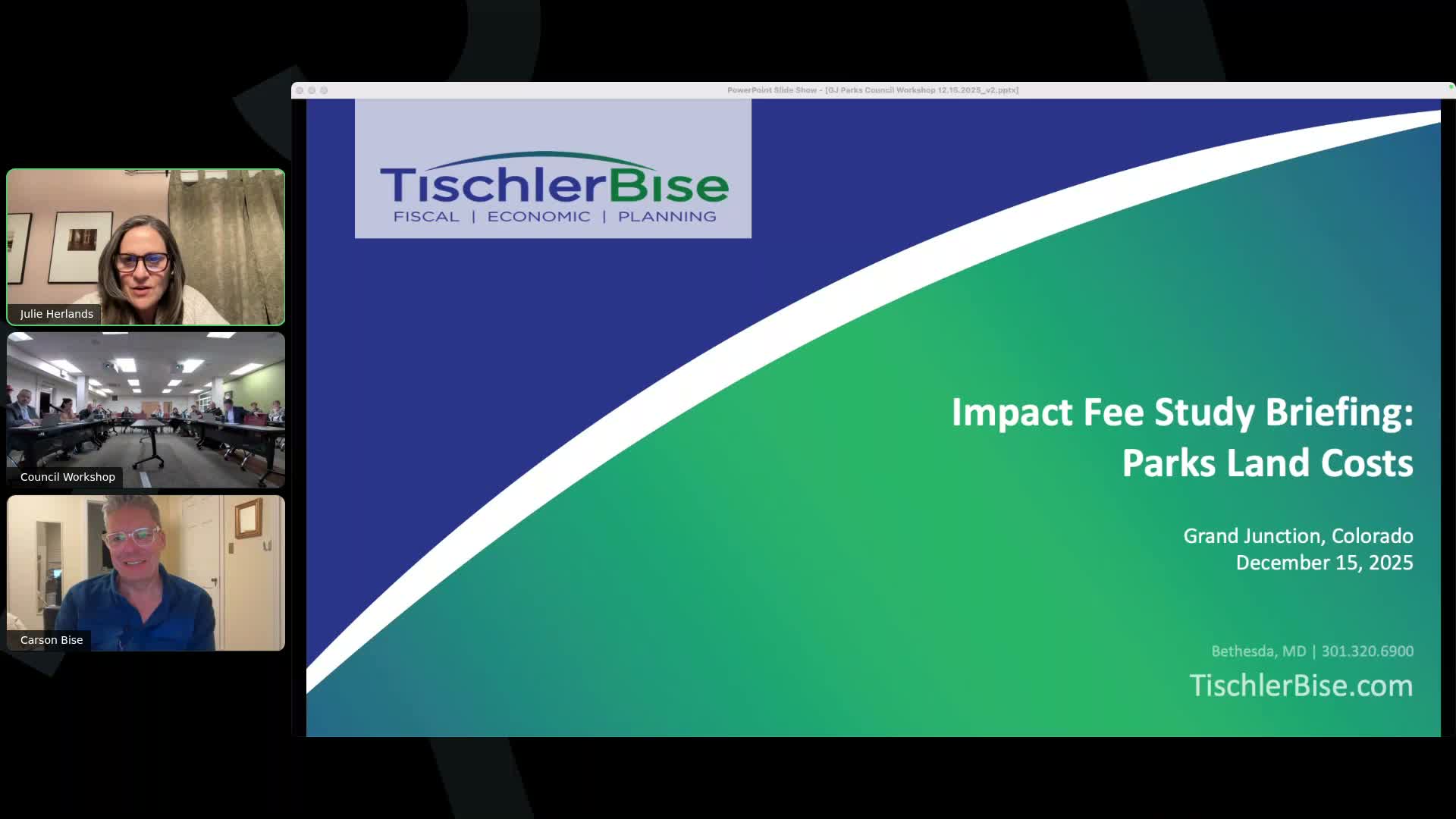
City staff and consultants reviewed revised parks impact-fee calculations at the Dec. 15 workshop and recommended a refined option that trims extreme land-value comparables to reduce the land-cost input used in the fee model.
Consultant Carson (Tishler Heiss) explained the baseline study used a weighted average land sale price of about $147,000 per acre and presented three alternatives: (1) remove downtown parcels (which are disproportionately multifamily/high-value comparables), (2) remove central-city parcels, and (3) remove the three highest and three lowest sale-price outliers. Trimming outliers (Option 3) reduced the land-value input to roughly $108,000–$114,000 per acre depending on truncation and produced lower maximum-supportable fee schedules across unit-size bands.
Council questioned methodology, the study’s policy goal (maintain current level of service vs. a targeted budget), and the affordability impacts. Legal counsel (Jeremiah) explained that the study produces a "maximum legally defensible" fee tied to the city’s current level-of-service calculations but that the council may consciously adopt a lower fraction of that maximum (for example 70%) as a policy decision and remain defensible if that choice is supported by the methodology and rationale.
Jeremiah and staff also outlined procedural options for timing: an emergency ordinance could be adopted immediately but requires unanimity; a regular ordinance could be introduced at first reading Jan. 7 and include rebate language for fees collected during the ordinance pendency. Staff recommended Option 3 following committee feedback and the council expressed informal consensus to move forward; staff will prepare an ordinance for the Jan. 7 first reading and public notice.
Council members discussed incentives and credits for developers that dedicate public parkland within subdivisions (example: Redlands 360 credits/IGA) and noted that credits already exist for qualifying public-park improvements. Council and staff also discussed review intervals for future fee studies (existing code ties review to six- and eight-year touchpoints) and staff recommended retaining review discretion rather than an automatic consultant-mandated schedule.
Next steps: staff to prepare ordinance materials for first reading Jan. 7 (with potential rebate language), publish public notices, and continue outreach to the home-builders association and other stakeholders.