Get Full Government Meeting Transcripts, Videos, & Alerts Forever!
Get email alerts on the Zoning Landscape Turf Ban topic
No spam. Unsubscribe anytime.
Grand Junction adopts zoning changes to implement Colorado'wide turf restrictions
Summary
The City Council on Dec. 3 adopted an amendment to Title 21 of the municipal code to implement state limits on nonfunctional turf, clarify irrigation zoning and adjust street-frontage landscape rules; the measure passed 4-2 after council questions about impacts on smaller multifamily projects and housing costs.
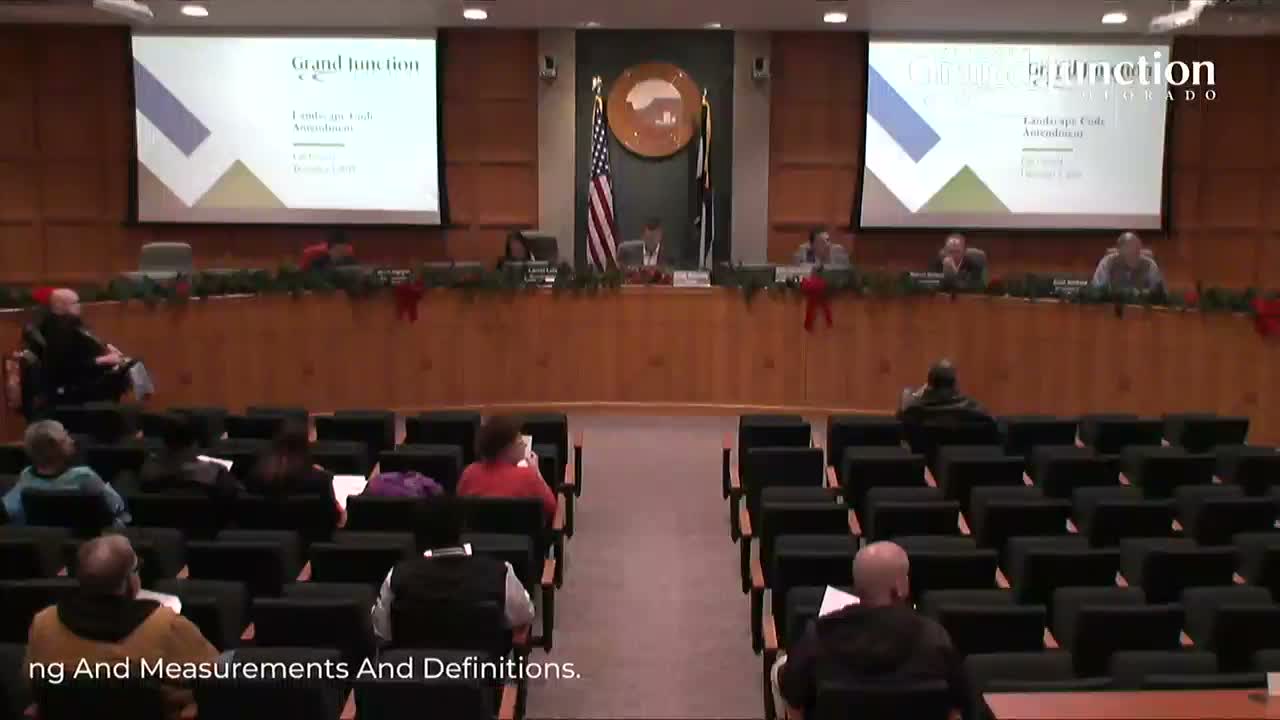
The Grand Junction City Council on Dec. 3 adopted an amendment to the city's zoning and development code that implements Colorado'level restrictions on the installation of nonfunctional turf and clarifies related landscaping and irrigation rules.
Principal Planner Tim Laerbach told council the amendment revises chapters 21.07 and 21.14 to prohibit nonfunctional turf on commercial, institutional, industrial properties, common-interest communities for developments of 13 or more units, and in rights of way, medians and parking lots, in line with state legislation that takes effect Jan. 1, 2026. Laerbach said native or hybridized arid grasses are exempt and that the code now distinguishes required landscape that must be irrigated from other landscape areas.
"The amendment broadens the applicability of the chapter from all required landscape to all landscape," Laerbach said, and added that the changes also resolve conflicts between recent front-setback reductions and street-frontage landscape requirements.
Council members pressed staff on scope and compliance. Council member Ballard and others asked whether the city was extending state requirements to smaller multi-unit developments. Laerbach clarified the state threshold applies to multi-unit properties with 13 or more dwelling units and that the local amendment is crafted to be "minimally compliant with the state," while folding in technical clarifications about irrigation hydro zones and a housekeeping deletion of a forward-looking irrigation designer deadline.
Council member Nguyen moved adoption on final passage. In a roll call vote the ordinance passed 4-2 (Ballard and Van Dyke voted no). The staff report notes the Planning Commission recommended approval by a 5-1 vote and staff found the amendment consistent with the comprehensive plan and water-conservation goals.
The ordinance creates a new definition for "functional artificial turf" and narrows field substitutions so turf cannot be substituted without prior written approval of the director of community development. It also removes a requirement that planting be installed close to structures, citing fire-safety and foundation concerns.
Council members and staff framed the action as implementing state law rather than expanding local regulation, but several members said they remained mindful of housing affordability and potential cost impacts on developers of required irrigation or alternative landscaping.
The council left open the possibility of future changes: Laerbach said some existing code elements remain subject to later action, and the city will continue technical refinement as the new state rules take effect.