Get AI Briefings, Transcripts & Alerts on Local & National Government Meetings — Forever.
Counseling Education Center asks Grand Junction to refund impact fees to close $500,000 gap
Loading...
Summary
The Counseling Education Center told the Grand Junction City Council it needs a refund of impact fees (the GCP fee) and other support to close a remaining $500,000 funding gap on a renovated Orchard Mesa counseling hub that was partly paid for with ARPA funds.
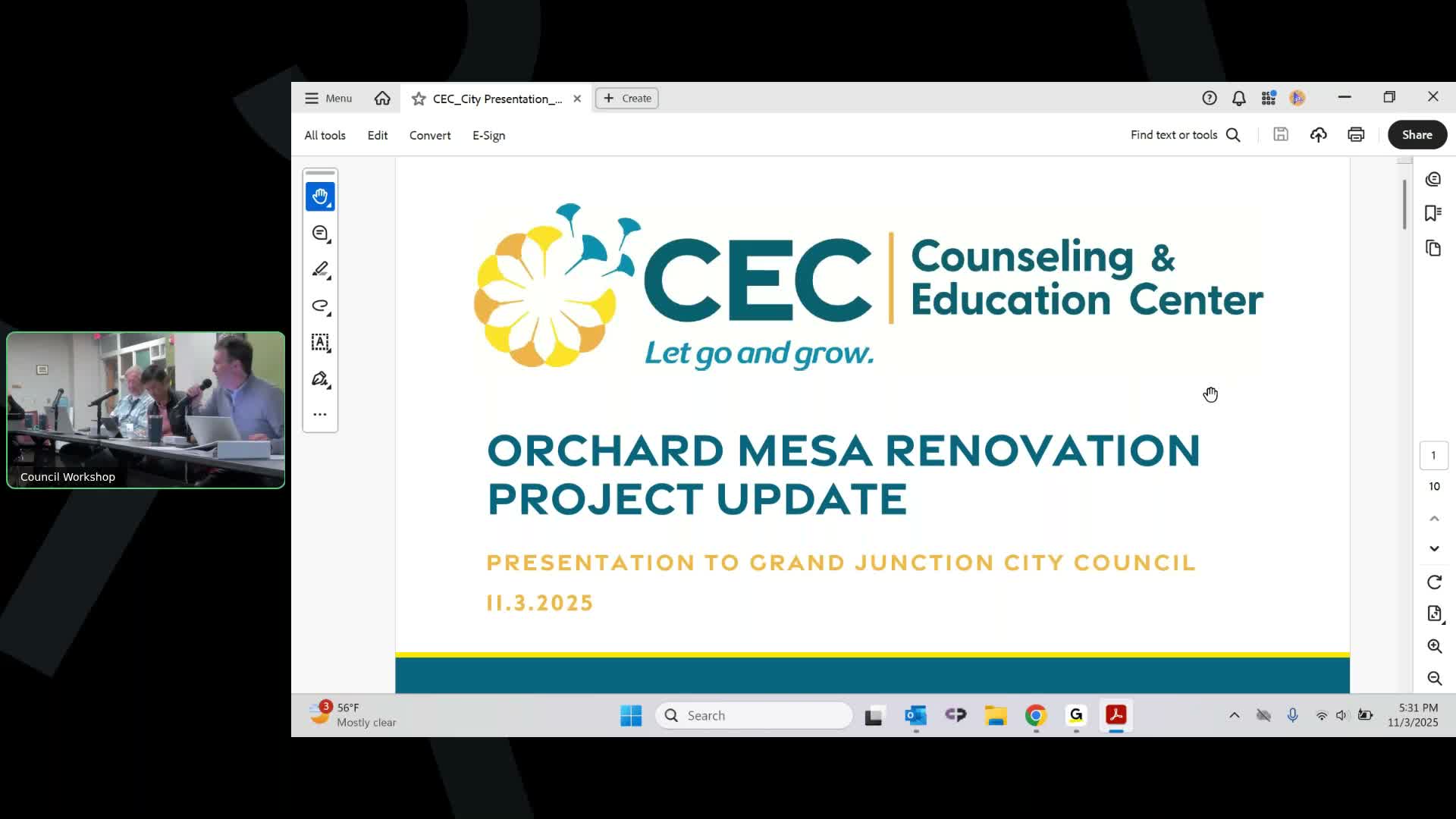
Hallie Nuremberg, executive director of the Counseling Education Center (CEC), asked the Grand Junction City Council on Nov. 3 to consider refunding impact fees to help finish renovation of an Orchard Mesa counseling center and expand services in a neighborhood with few mental-health resources.
Nuremberg said the nonprofit purchased the building in September 2023 and had used American Rescue Plan Act funding (about $996,006) to expand services. She told council the original renovation budget was about $495,000 but a change-of-use permit, added site work (including hard-surface parking, drainage and landscaping), ADA and life-safety work and permit/impact fees produced roughly a $1 million increase in project costs; CEC reports it has raised half of that shortfall and has a remaining gap of $500,000.
The request would be a targeted refund of impact fees, specifically the GCP fee, not a new ongoing program. "We are hoping that our project is providing to the benefit of the city as a whole and so that this would be a humble request, from you all," Nuremberg said. She also described steps the nonprofit has taken to limit future overruns: hiring an owners representative to audit scope and budget, splitting the work into two phases, renegotiating the contractor contract toward a stipulated-sum arrangement and building contingency reserves.
CEC officials said the completed site will roughly double the agencys annual capacity. Nuremberg said the two locations together are on track to serve 700to 800 predominantly low-income counseling clients annually and that roughly 60to 70% of the clients use Medicaid or CHIP.
City staff told council that if members direct support for the request, staff would prepare a supplemental appropriation ordinance and bring it back for formal action (staff indicated the likely funding source would be reserve fund balance). Several council members expressed support and urged staff to return with the ordinance language and costs.
Council did not take a formal vote at the workshop; staff said they would return with a formal supplemental appropriation ordinance and any recommended terms for fee refund or grant support before the end of the year.