Get Full Government Meeting Transcripts, Videos, & Alerts Forever!
Get email alerts on the Local Tax Policy topic
No spam. Unsubscribe anytime.
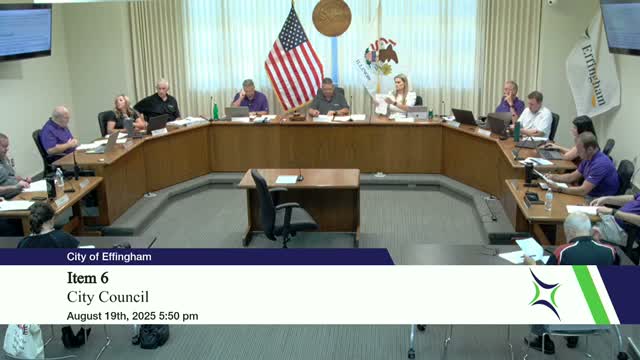
Effingham council weighs 1% sales tax, possible grocery tax reinstatement and repeal of amusement tax
Summary
City staff briefed council on three linked tax ordinances: a proposed 1% local sales tax (estimated $6.5M), possible local reinstatement of a grocery tax (≈$650K–$700K) and repeal of a 5% amusement tax (≈$165K). Council asked staff to refine options and return for vote in September.
City officials on Monday laid out three linked tax measures that would shift how Effingham raises revenue and could let the city reduce the property‑tax levy.
The city administrator presented Ordinance 55‑2025, a potential non‑home‑rule 1% sales tax that staff estimated would have generated about $6.5 million on last year’s sales base; Ordinance 64‑2025 would allow the city to reimpose a grocery tax (staff estimate: roughly $650,000–$700,000), and Ordinance 63‑2025 would repeal the city’s 5% amusement tax, which yielded about $165,000 last year and funds tourism efforts.
Why it matters: city leaders said the suite of measures, if adopted before the state deadline, would permit the council to substantially lower the city’s portion of the property‑tax levy while preserving revenue for operations and mandated expenses such as police and fire pensions. Staff warned the measures are legally and administratively distinct: the grocery tax has been collected at the state level and could be locally reimposed, and the sales tax can be implemented in 0.25% increments. The city must submit ordinances to the state by Oct. 1 for a Jan. 1, 2026 effective date.
Council members debated distributional effects and communications. Several commissioners said residents in municipalities outside Effingham city limits would not see the benefit of a city sales‑tax change, while staff noted the interstate traffic and nonresident shoppers that drive much of retail receipts in the city. “If you pass the sales tax, we would put very minimal numbers in [the levy],” the City Administrator said, explaining the council could show a symbolic figure — not literally zero — on the tax levy line. A council member urged careful messaging: “People hear the word ‘tax’ and stop listening.”
No ordinance was voted on Monday; council direction was to refine the drafts, clarify whether the state will assess administrative fees, and return at the council’s Sept. 16 meeting (or at a special meeting) with staff recommendations and communication materials. Staff emphasized the timeline: to collect locally on Jan. 1 the ordinances must be submitted to the state by Oct. 1.