Get Full Government Meeting Transcripts, Videos, & Alerts Forever!
Get email alerts on the Immigration Enforcement topic
No spam. Unsubscribe anytime.
Chicago police leaders reiterate refusal to aid federal immigration enforcement, cite policy and consent-decree progress
Summary
Deputy Mayor Gary Gatewood and CPD leadership told the Police Board that Chicago will not assist federal immigration enforcement, pointing to the Welcoming City ordinance and Special Order SO6-1403; CPD also reported gains in consent-decree compliance and announced community training observation days.
Deputy Mayor Gary Gatewood told the Chicago Police Board on Oct. 16 that the city has seen an increased presence of federal agents but will not assist with immigration enforcement because Chicago is a "welcoming city." Gatewood said the mayor's office launched a Protect Chicago website with 'know your rights' and homelessness resources and that the city is preparing for a large, expected peaceful protest this weekend.
"We operate under the welcoming city ordinance," Gatewood said, adding the mayor's office worked with the Department of Law, CPD and immigrant-rights staff to assemble public information. "We also put out a lot of information ... to make sure we had all the information ready and prepared." He urged residents to verify reports about federal agents before sharing them, saying unverified claims can place people at risk.
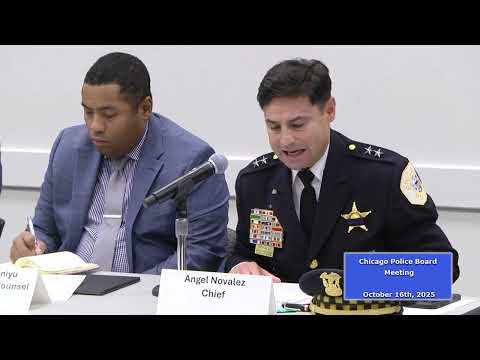
Chief Angel Novales, speaking for the superintendent, quoted the department's Special Order SO6-1403, Responding to Incidents Involving Citizenship Status, and said CPD officers "do not enforce immigration law." Novales said officers will not detain someone solely on the belief that the person committed a civil immigration violation, will not rely on immigration detainers to continue detention, and will not provide department facilities to immigration agents for investigative interviews. He added that the department may act if a contemporaneous public-safety threat arises.
Novales also announced that the twelfth independent monitoring report assessing CPD's consent-decree compliance (IMR 12) was filed today and reported "significant increase[s] in all the levels of compliance" in areas including use of force, community engagement and officer wellness. The department is sharing more opportunities for public participation, Novales said, including community training observation days open to the public; the next session is scheduled for Oct. 25.
COPPA Chief Administrator Lakenya White told the board COPPA cannot regulate federal agencies such as ICE but can direct residents to oversight channels and investigations; she noted COPPA's 2025 third-quarter report is available online and described recent portal updates intended to make complaint filing and public engagement clearer.
The board did not take formal action on immigration policy at the meeting. Written materials and the department's posted policies, Novales said, remain available for public review.