Get Full Government Meeting Transcripts, Videos, & Alerts Forever!
Get email alerts on the Subdivision Regulations Rewrite topic
No spam. Unsubscribe anytime.
Guadalupe County officials, consultants outline multi‑phase rewrite of subdivision and development regulations
Summary
At an Aug. 5 workshop, county leaders and Freese and Nichols consultants presented a diagnostic report and proposed a phased rewrite of Guadalupe County's subdivision and development regulations to address traffic impacts, fees, minor plats, manufactured‑home communities and interlocal agreements with cities.
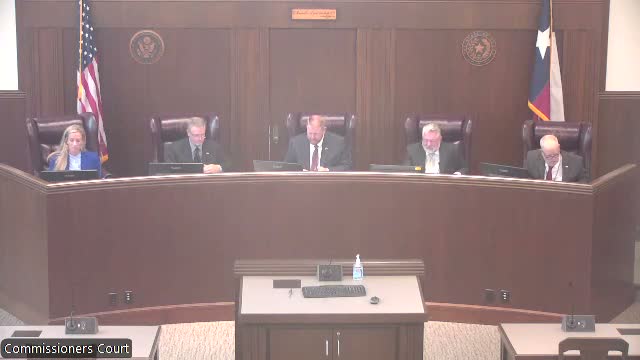
Guadalupe County officials and consultants from Freese and Nichols, Inc., on Aug. 5 laid out a multi‑phase plan to rewrite the county's subdivision and development regulations, saying the goal is to clarify standards, assign infrastructure costs fairly and prepare the county for rapid growth.
"Our discussion today is the Guadalupe County subdivision regulations," the presiding judge said as he opened the workshop. Barry Black, who introduced the consultants, said the work marks a milestone in updating rules to fill gaps related to commercial development and other emerging needs.
Daniel Harrison, a planner with Freese and Nichols, summarized the project as a four‑phase effort. Phase 1 included a diagnostic report and triage amendments the county has put in effect; Phase 2 will produce a comprehensive rewrite and a development application handbook with checklists and flowcharts; Phase 3 will address fee schedules to cover review and enforcement costs; and Phase 4 will develop engineering standards for roads and drainage.
Harrison highlighted a set of priority findings the team will target in Phase 2, beginning with restructuring the regulations so users can find the applicable standards more easily and avoiding repetitive or dense numbering. He also said the team will update references to state legislation and include clear citations, noting that the Local Government Code will be hyperlinked in draft materials for transparency.
Traffic impact analyses (TIAs) were singled out as a critical element. Harrison said TIAs, already added in triage amendments, will be beefed up and tailored to county conditions so they can justify requirements such as turn lanes and other off‑site improvements.
"That's going to be an important element because as traffic increases, how do we understand and how do we if someone's going to need a turn lane into a subdivision, what's the rationale or the backup for making that developer provide the infrastructure that's needed?" Harrison said.
Commissioners asked how TIAs might influence signalization. Harrison replied that TIAs can show expected intersection volumes and support signal decisions, while noting counties use different planning assumptions than cities because counties typically lack zoning authority.
The consultants also proposed clearer rules on application completeness and the county's 30‑day plat review clock. They described three approaches: a strict calendar start, a 30‑day waiver to allow iterative staff‑applicant exchanges, or requiring technical completeness before a review clock starts. Harrison said the team generally favors either allowing staff‑applicant workarounds or requiring technical completeness to avoid "going dark" on applicants during the statutory review period.
On fees, Harrison said the county should aim to recover the cost of review and enforcement through application and inspection fees while noting some counties choose to subsidize reviews as a policy decision. Commissioners cautioned that very high per‑lot fees could be perceived as revenue generation rather than cost recovery.
The workshop also addressed specific topics including condominium plats and multifamily regimes (noting private or public roads still require drainage and fire‑access review), thresholds and delegation for minor plats (the consultants discussed a four‑lot threshold with potential acreage limits), and regulation of manufactured‑home rental communities to ensure emergency access and infrastructure.
The consultants urged a standardized approach to interlocal agreements (ILAs) with the county's cities and annual updates to ETJ (extraterritorial jurisdiction) maps so applicants and staff can easily determine whether city or county review applies. Participants noted the county's 11 different ILAs are written inconsistently and said a county template could streamline negotiations with municipalities.
Speakers flagged the scale of buildable acreage already in process in unincorporated areas. One commissioner estimated "somewhere around 15,000 lots that are already platted," and consultant comments referenced a proposed northeast county development of about 3,300 homes, both of which underscore the fiscal and service implications for county roads, emergency services and schools.
Staff and the consultants emphasized administrative steps to improve submittals, including mandatory predevelopment meetings, checklists and clearer application guidance to reduce repetitive resubmissions. Barry Black said the diagnostic and triage work has come in "significantly under budget," and the team recommended a legal review before releasing rules for public consideration.
The county did not take formal action at the workshop. Consultants said proceeding to Phase 2 is recommended if the court wants a full rewrite and accompanying handbook; final adoption steps and fee scheduling would come later and include legal review and additional negotiations with city partners.
The court closed the workshop after questions and thanked staff and consultants for their work. The consultants said they will continue coordinating with county staff as the rewrite progresses.