Get Full Government Meeting Transcripts, Videos, & Alerts Forever!
Get email alerts on the Housing And Homelessness topic
No spam. Unsubscribe anytime.
Lake County officials warn HUD CoC funding changes could force reallocation and affect more than 170 households
Summary
County staff told the Health and Community Services Committee that recent HUD Continuum of Care rule changes reduced the protected funding tier from about 90% to 30% and capped permanent supportive housing allocations at 30%, creating uncertainty for providers and potentially affecting roughly 172 households who currently receive rental assistance.
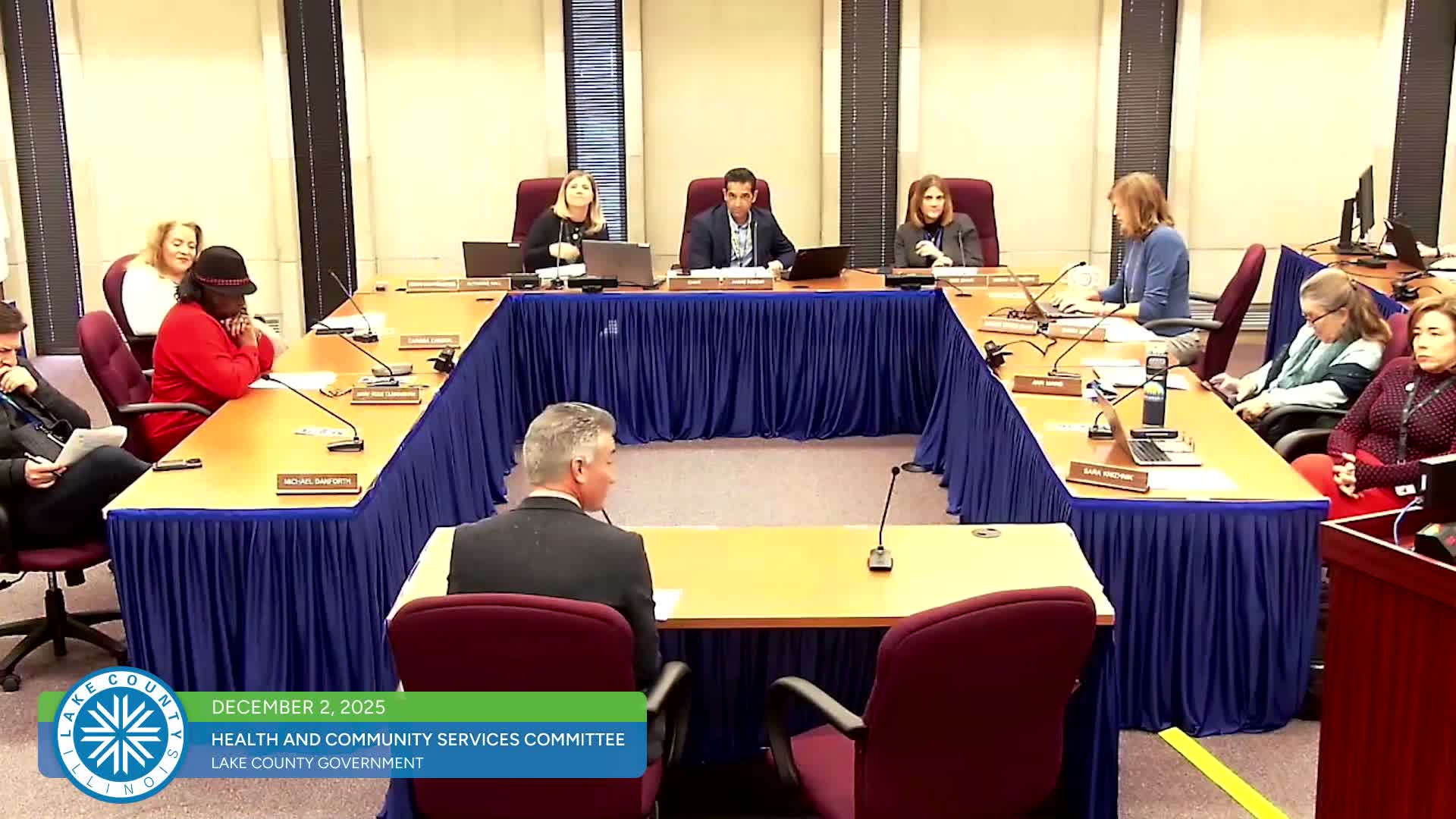
Lake County Community Development staff told the Health and Community Services Committee on Dec. 2 that abrupt changes to HUD’s Continuum of Care (CoC) application and funding rules will force serious program adjustments and may put long-term rental assistance for dozens of households at risk.
Dominic, a county housing official, briefed the committee on adjustments to the CoC application process and funding allocation. He said the county’s typical annual CoC award was roughly $3.5 million and that, historically, about 90% of those funds were treated as protected (tier 1). "This year... that cap is dropped down to 30%," Dominic said, adding that HUD also imposed a cap limiting the share of funds that can be used for permanent supportive housing to 30 percent. Staff warned those changes will require reallocation toward transitional, time-limited programs and could disrupt existing rental-assistance contracts.
Dominic said about 172 households currently receive assistance funded through the CoC rental-assistance portfolio and will be a top priority to protect, but he stressed that timing and funding uncertainties make the path forward difficult. The committee pressed staff on mitigation options, and several members urged aggressive county action and clearer data on the scale of need. Member Kasman called the policy shift "insane. Unnecessarily disruptive, chaotic, cruel, and wrong." Another committee member argued the county’s long-term supportive housing approach is cost-effective, saying it costs "40 to $50,000" per unhoused person on the street when broader public costs are considered.
Staff described several tactical responses: maximizing the county’s application to obtain as much CoC funding as possible, applying for transitional grants that allow existing permanent-supportive projects short-term transition funding, and working with providers to minimize disruptions to households. Dominic also told the committee that two lawsuits challenging aspects of the CoC funding changes had been filed recently; he did not expect quick resolutions from litigation.
Committee members asked what the county could do beyond application strategy, including whether to lobby HUD or engage state and federal representatives; staff said the state has convened working groups and a local role is limited but that the county would pursue available strategies. The application deadline noted in the meeting was Jan. 15, with local competition due Dec. 12; staff said decisions on award amounts are typically known a couple months after submission, leaving a short window to adjust contracts and leases that expire in early 2026.
Members asked staff to quantify funding gaps and present specific mitigation options at a future meeting. Dominic said preserving current households and minimizing displacement are top priorities while staff explore transitional grant opportunities and reallocations.
The committee approved a separate, routine amendment to the PY2025 HUD Annual Action Plan that reallocates roughly $77,000 of expiring CDBG funds to uphold an obligation to the Youth Conservation Corps of Waukegan, by using HOME program income to free up CDBG funds; that amendment passed with one abstention.