Get Full Government Meeting Transcripts, Videos, & Alerts Forever!
Get email alerts on the Urban Forestry topic
No spam. Unsubscribe anytime.
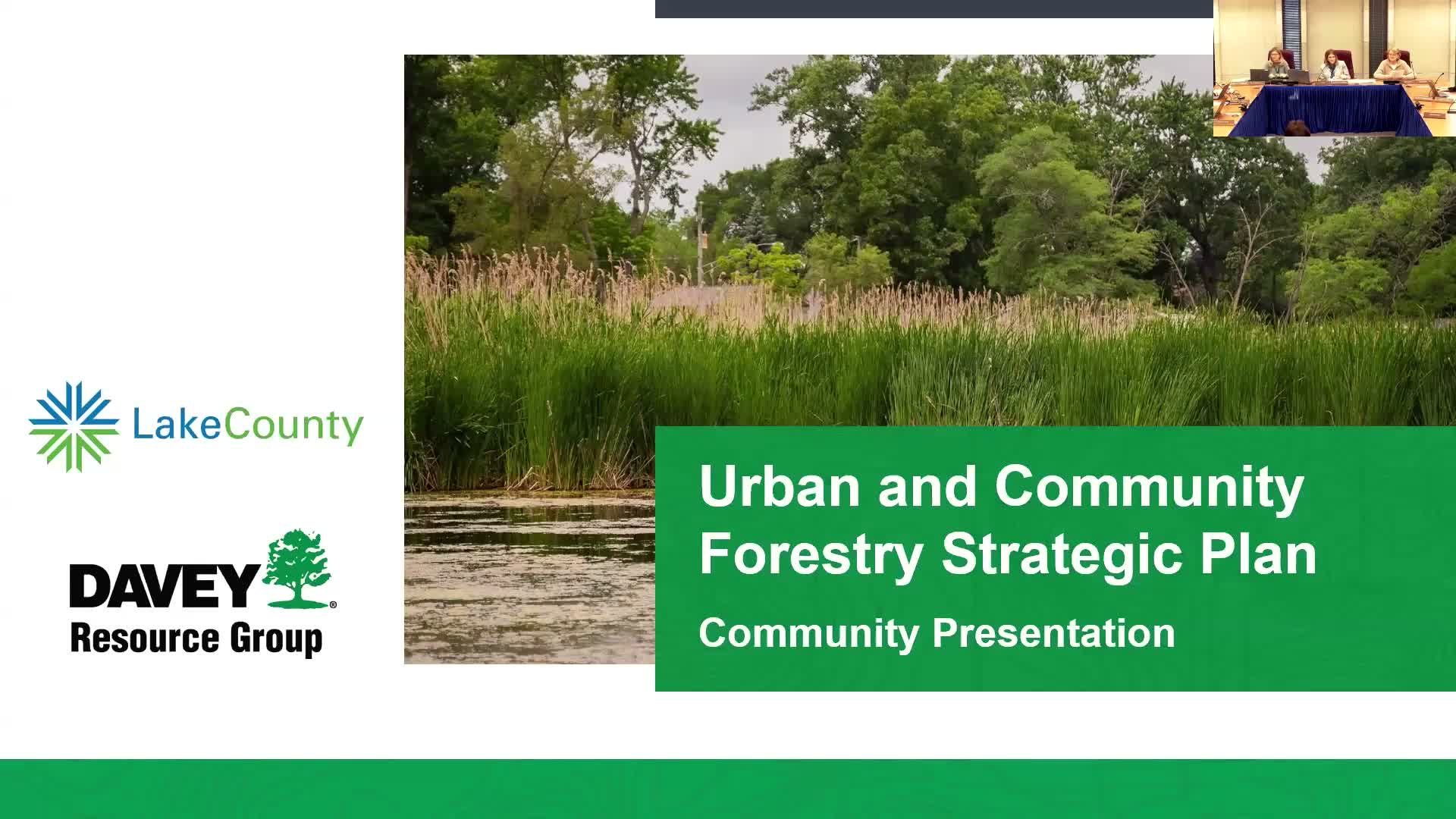
Lake County committee forwards Urban and Community Forestry Strategic Plan for county board adoption
Summary
After a presentation by consultants and county sustainability staff, the committee voted to forward Lake County’s Urban and Community Forestry Strategic Plan, which sets canopy goals, invasive species control, workforce development and public‑education priorities. The measure will go to the county board for adoption.
The Planning, Zoning and Environment Committee on Dec. 3 voted to forward an Urban and Community Forestry Strategic Plan to the full county board for adoption.
Robin Hallgrim (formerly Grooms), Lake County’s sustainability programs manager, introduced the plan and said it builds on the county’s Tree Initiative and aligns with regional efforts. Consultants from Davey Resource Group summarized methods and findings, including canopy analysis, stakeholder engagement and a steering‑committee process.
Matthew Erb of Davey Resource Group said Lake County’s canopy coverage varies widely by community — from about 9% in some places to as high as 62% in others — and that canopy assessments and tree‑species data show a heavy presence of nonnative invasive species. The presenters estimated European buckthorn comprises a large share of the county’s tree population and noted that 80% of surveyed trees were under 5 inches in diameter, indicating many young or small trees.
The plan frames five strategic priorities: collaborate (countywide coordination and technical support), plant (countywide canopy goals and incentives), regenerate (control nonnative invasive plants and increase species diversity), train (workforce development and career pathways), and educate (public outreach and stewardship). Each action in the plan includes suggested partners, timelines, metrics and estimated cost ranges to help prioritize implementation.
Committee members asked about coordination with Lake County Forest Preserve, the role of community colleges or workforce partners, and whether some sites might be better suited for prairie or wetland restoration rather than tree planting. Presenters said they engaged the forest preserve and other stakeholders and that the plan prioritizes trees only where analysis shows they will provide benefits.
Member Kanishnik moved to forward the resolution and Member Wasek seconded. The motion passed by voice vote. Staff said the plan will be posted on the county sustainability page and forwarded to the county board for adoption.