Get Full Government Meeting Transcripts, Videos, & Alerts Forever!
Get email alerts on the Stormwater Debris Dam topic
No spam. Unsubscribe anytime.
Lake County stormwater staff identify debris jam and failing dam on Indian Creek; plan removal and interjurisdictional talks
Summary
Stormwater Management Commission staff told the Planning, Zoning and Environment Committee they found a large interjurisdictional debris jam blocking the Indian Creek floodway and a failing sheet‑pile low‑head dam; staff said removal of the debris is the immediate priority, will require coordination with Illinois DNR and property owners, and may pursue grant match for broader restoration.
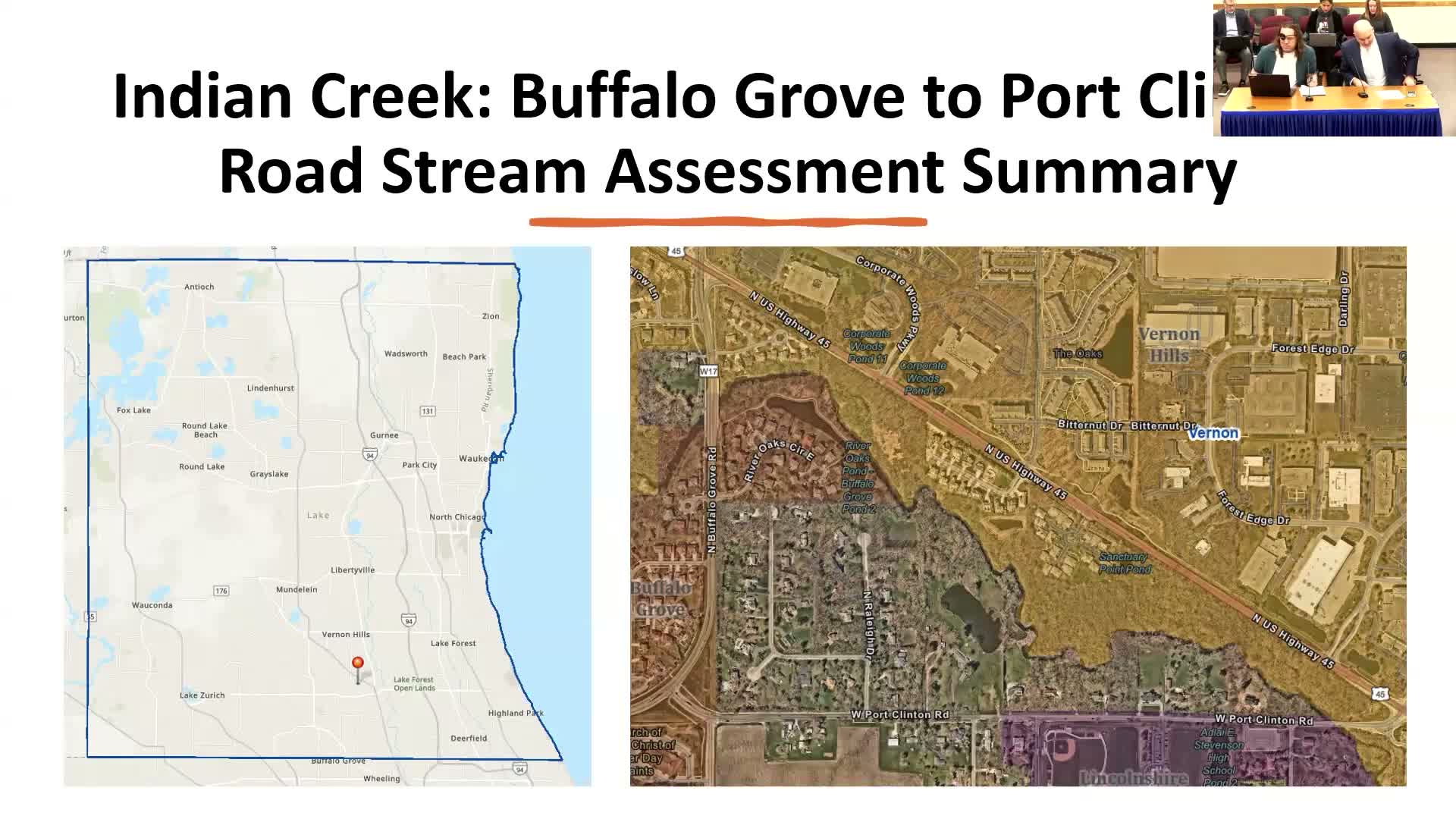
Stormwater Management Commission (SMC) staff on Dec. 3 briefed the county Planning, Zoning and Environment Committee on an Indian Creek assessment that identified a large debris jam blocking a substantial portion of the floodway and a failing sheet‑pile low‑head dam within an interjurisdictional reach spanning Buffalo Grove Road to Port Clinton.
Jacob Josephowski, the county’s water‑resources professional, said the study area sits within a roughly 38‑square‑mile watershed and includes unincorporated Lake County plus portions of Buffalo Grove, Vernon Hills and other municipalities. He said field visits, drone imagery and community meetings in 2024 helped identify habitat features (notably mature oaks and dense mussel shell deposits) and problem sites.
“This is the bigger issue that SMC is focusing on right now, because we feel that this is negatively impacting drainage and as a flood risk,” Jacob said, referring to a large debris accumulation that appears to be blocking the floodway. He said the debris jam spans jurisdictional lines, sits partly on private property and likely includes material carried downstream from Lake Zurich, Mundelein and unincorporated areas.
Kurt Wolford, head of SMC, and Jacob said they have legal authority under state statutes to perform removal work in regulated floodways but will coordinate with the Illinois Department of Natural Resources (DNR) and follow counsel guidance. County counsel advised that any work must remove debris completely — not only displace it — and that the county is responsible for restoring property damaged by removal operations.
On the failing structure, Jacob described a sheet‑pile dam that is being undercut as the stream migrates; residents and some property owners oppose removal for aesthetic reasons, while Buffalo Grove officials at the SMC meeting expressed support for removal. SMC said dam removal is not the maintenance program’s immediate plan because the property owner has opposed removal and because removal raises other permitting and jurisdictional questions; however, it remains a potential future project within the watershed plan.
SMC listed practical next steps: contact and negotiate with the private property owner(s) where the debris jam sits, pursue DNR review and necessary permits, remove the jam using site‑appropriate methods (on‑site equipment backed up by consultants for bigger items), ensure complete removal and offsite disposal, and stabilize/restoratively reseed impacted banks. Jacob emphasized that some woody debris and small material may remain but large accumulations that block conveyance must be removed.
Staff discussed grant opportunities — citing EPA Section 319 as one example — if broader restoration and match funding can be secured. Committee members asked about timing; staff said late spring or early summer is preferable pending DNR review and weather conditions.
The committee asked staff to keep the board and district representatives updated as the county pursues removal authorization and potential restoration funding.