Get Full Government Meeting Transcripts, Videos, & Alerts Forever!
Get email alerts on the Infrastructure Flooding topic
No spam. Unsubscribe anytime.
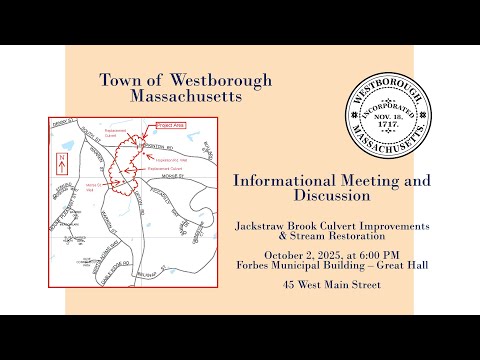
Westborough presents four options to curb Jack Straw Brook flooding; removing Moore Street is cheapest
Summary
Westborough DPW and consultants presented four alternatives to reduce flooding on Jack Straw Brook, from in-kind culvert replacement to removing 230 feet of Moore Street and restoring wetlands (Alternative 4, est. $4.3M). Staff said removing a road would require a town meeting vote; residents pushed for traffic and pedestrian studies.
Westborough officials on Thursday laid out four engineering options to address recurrent flooding along Jack Straw Brook in the Upton–Morris–Hopkinton area, saying the town must balance protecting a nearby water-supply pump house and key roads with neighborhood access and cost.
Chris, of the Department of Public Works, opened the meeting and emphasized the project’s goals: protect the town’s well and related pumping equipment, reduce the risk that stormwater will damage utilities or cut emergency routes, and comply with modern stream-crossing and permitting standards.
Fuss & O’Neill consultants said the study area contains 11 culverts within roughly a half-mile and that many are undersized for today’s storm patterns. April Duroski, a wetland scientist with Fuss & O’Neill, said historic maps show Jack Straw Brook once followed a more sinuous, natural channel, and the team considered restoring that alignment as a way to reduce overtopping and reconnect wetlands.
Lara Supp, senior resilience engineer with Fuss & O’Neill, summarized the four alternatives: replacing culverts in kind with no change to Moore Street (Alternative 1); realigning the stream while preserving Moore Street and adding a large culvert under it (Alternative 2); realigning and raising Moore Street (Alternative 3, which the team’s modeling found would back up water and worsen flood elevations for neighbors); and removing roughly 230 feet of Moore Street to restore a pilot channel and wetland (Alternative 4).
The consultants estimated Alternative 4 at about $4,300,000 and said it reduces modeled FEMA flood boundaries by providing more floodplain volume and aquatic passage. "Alternative 4 is approximately $4,300,000," Supp said during the presentation. The team said culvert replacements in Alternatives 2–4 would use wider openings (about 20 feet) to meet Massachusetts stream crossing standards and improve aquatic and terrestrial passage.
Holden Sparachino of the Division of Ecological Restoration described the agency’s grant programs that helped fund the design work and said state programs reward projects that meet stream-crossing standards. He also noted broader state and MassDOT funding for resiliency projects.
No formal decision or vote was taken. DPW said the project is in design and permitting, that Division of Ecological Restoration design funding is available through June, and that removing a road would require a separate town meeting vote. Chris said the town expects to complete design and go to bid within months if the project advances and that construction could begin in 2027 if funded and phased.
Residents raised recurring concerns. Several speakers said removing Moore Street would divert vehicles and cyclists onto Warren Street and the Upton/Hopkinton intersection, increasing safety risks for children and pedestrians. "If this goes through with no pedestrian and bicycle pathway, you're gonna put kids ... to that crazy intersection," said Alan Brule, a Moore Street resident. Others suggested that enlarging specific culverts under Upton and Hopkinton roads might solve the problem with less disruption, and engineers said some targeted replacements are possible but can be long, expensive, and carry ecological tradeoffs.
Presenters acknowledged the trade-offs and said pedestrian connectivity could be included in project design if the town pursues road removal, but that additions would raise cost and may trigger additional permitting. Baseline traffic counts presented at the meeting showed roughly 250–300 vehicles per day on the Moore/Warren segment under discussion; DPW said a formal traffic study would be done only if the town moves the project toward a funding vote.
Several residents asked for clearer, quantified benefits to the town’s aquifer and well. Officials described groundwater recharge as a potential secondary benefit of restoring wetlands and slowing flows, but said that benefit was not quantified in the current modeling and that the pump-house renovation is a separate, overlapping project tied to regulatory requirements for secondary containment.
Next steps: DPW will incorporate public feedback into the design, continue permitting and funding efforts, and—if the town chooses to pursue road removal—present a warrant article at a future town meeting for a vote on discontinuing Moore Street and, separately, for funding. The project team provided contact information for follow-up and collected public comments at the meeting.