Get Full Government Meeting Transcripts, Videos, & Alerts Forever!
Get email alerts on the Prescription Drug Pricing topic
No spam. Unsubscribe anytime.
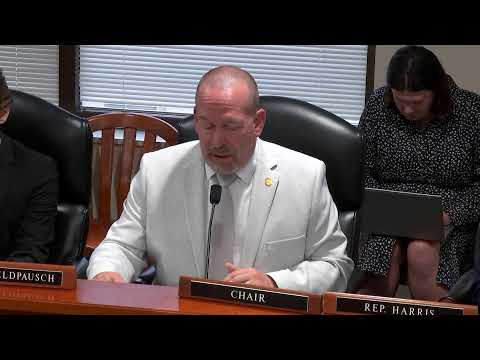
House Insurance Committee reports House Bill 4464; PhRMA witness outlines concerns about 340B, PBMs
Summary
The Michigan House Insurance Committee voted to report House Bill 4464 with a recommendation that it pass after a motion to reconsider; the committee also heard testimony from Leslie Wood of the Pharmaceutical Research and Manufacturers of America about prescription drug costs, pharmacy benefit managers and the federal 340B program.
The Michigan House Insurance Committee reported House Bill 4464 with a recommendation that it pass after a motion to reconsider and a second roll call; the final committee vote was 10-0 in favor. The panel also heard a presentation from Leslie Wood of the Pharmaceutical Research and Manufacturers of America about prescription drug pricing, pharmacy benefit managers and the federal 340B Drug Pricing Program.
The committee's initial motion to report House Bill 4464 with a recommendation that it pass was made by Representative Aragona and passed on a first roll call (recorded as 9 yays, 0 nays). Representative Carter later moved to reconsider that vote; the motion to reconsider passed (recorded as 10 yays, 0 nays). Representative Aragona renewed the motion to report HB 4464, and the committee again recorded a unanimous roll-call vote in favor (10 yays, 0 nays). The clerk recorded the final outcome as “House Bill 4464 is reported with recommendation.”
During the meeting the committee received a presentation from Leslie Wood, identified in the record as regional vice president of state policy for the Pharmaceutical Research and Manufacturers of America (PhRMA). Wood told the committee that prescription medicines have accounted for a relatively stable share of total health-care spending—“in the range of about 10 to 14% of the health-care dollar”—and said net spending on medicines rose by about 2.3% in 2023. She emphasized the role of generics, saying “Nearly 90% of all prescription medicines are filled with a generic medicine,” and cited large aggregate savings from generics and biosimilars between 2013 and 2022.
Wood focused much of her testimony on pharmacy benefit managers (PBMs) and the 340B Drug Pricing Program. She said three PBM-related companies control roughly 80% of the market and that PBMs influence coverage decisions, prior authorization requirements and patient out-of-pocket costs. On 340B, Wood told the committee that the program has grown substantially, citing an increase from about $12 billion in 2013 to roughly $66 billion in 2023 and saying the program’s expansion has coincided with large hospital markups for certain medicines. She stated that some hospitals mark up common medicines by about 500% and cited examples of higher markups for oncology medicines.
Wood argued that 340B growth can raise costs for employers and state and local governments because drugs dispensed under 340B do not generate duplicate manufacturer rebates for insurers and PBMs. She gave rounded national estimates presented to the committee for additional costs she attributed to the program: roughly $6.6 billion in extra costs to employers and about $1 billion to state and local governments; she identified Michigan-specific figures of about $272 million in extra costs to Michigan employers and about $34 million to state and local government, as presented to the panel. Wood also described contract pharmacy arrangements and stated that a small number of large pharmacies—named in her remarks as Walgreens, Walmart, CVS Health and Accredo—account for a substantial share of contracted 340B pharmacy activity.
Vice Chair Gerter asked how the committee could ensure patients are the primary beneficiaries of 340B. Wood replied that 340B is a federal program and that states can study program integrity and employ tools such as claim modifiers and audits; she cited state reports from Minnesota and North Carolina as examples of state-level analysis.
Committee business aside from HB 4464 included a motion, made by Vice Chair Carter, to approve the minutes from the May 7 meeting, which were approved without objection, and a motion to excuse absent members, also handled without objection. With no further business, the committee adjourned.
The record does not include the text of House Bill 4464, sponsors beyond the committee motion to report, or committee commentary directly describing the bill's provisions; the transcript shows only the committee's motions, roll-call outcomes and the PhRMA presentation as described above.