Get Full Government Meeting Transcripts, Videos, & Alerts Forever!
Get email alerts on the Urban Agriculture topic
No spam. Unsubscribe anytime.
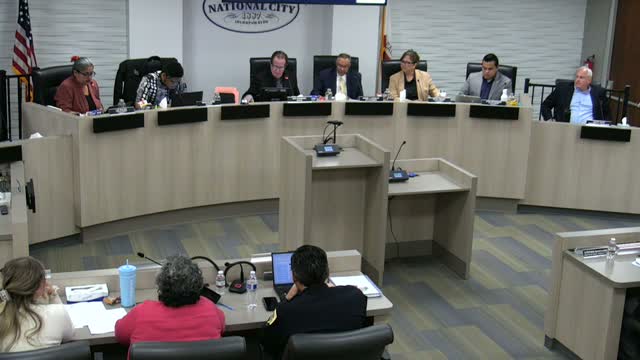
Council continues chicken-keeping ordinance to Aug. 18, asks staff for more research
Summary
After a wide-ranging public hearing and contrasting views from residents, the council voted to continue consideration of amending the municipal code on hen chickens (NCMC §8.32.015) to the second meeting in August for further analysis and comparative research.
The National City Council opened a public hearing on proposed changes to Municipal Code section 8.32.015 to allow greater numbers of hens on single-family properties and to remove a 20,000-square-foot lot-size restriction. After more than an hour of public testimony and discussion, the council voted unanimously to continue the item to the second meeting in August (target date: Aug. 18) so staff can compile comparative regulations and more detailed data.
Assistant Director Martin Reeder presented the staff report summarizing the code history: in an earlier ordinance single-family properties had been allowed more birds, the number was later reduced to four and a 20,000-square-foot lot-size requirement added. The draft amendment considered by council would again allow up to 12 hens on single-family parcels and remove the 20,000-square-foot minimum; roosters would remain prohibited.
Council member Rodriguez — who brought the policy request forward — said the item was intended to reconnect residents with food sources and expand urban agriculture opportunities while protecting neighbors. “I think it is important that we get reconnected with our food source,” Rodriguez said during public comment. Supporters at the podium described benefits including food security and educational food programs, while opponents and some council members raised enforcement, nuisance, animal-health and vector-control concerns that had prompted the prior change back to a more restrictive rule.
Residents who testified included current chicken keepers describing humane care and the value of fresh eggs as well as speakers who said poor enclosures can attract rats, produce odor and lead to complaints and code enforcement costs. Staff and council members asked for further detail about reasonable lot-size thresholds, per-chicken run dimensions and public-health guidance; council agreed to ask staff to return with examples from comparable cities and recommended limits (e.g., options in the 4–12 range, possible minimum lot sizes below the existing 20,000-square-foot threshold), plus any applicable state or county health advisories.
The council’s continuation request directs staff to return at the scheduled meeting in August with comparative analyses and recommended ordinance language. No final policy or vote on the substantive code change occurred at the May 20 meeting.