Get Full Government Meeting Transcripts, Videos, & Alerts Forever!
Get email alerts on the Sewer Rates topic
No spam. Unsubscribe anytime.
National City adopts sewer service charges for fiscal years 2026–2030
Summary
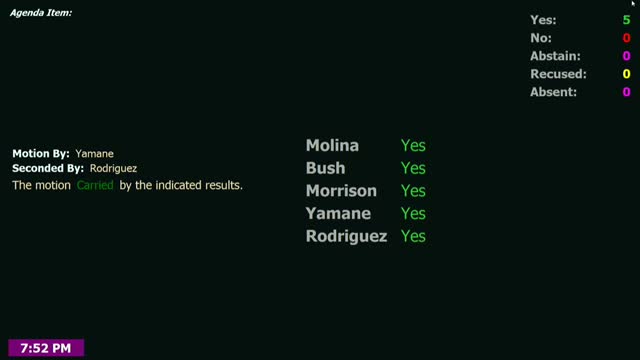
After a public hearing and technical presentation, the City Council voted unanimously to adopt an ordinance updating sewer service charges for FY26–30, approving roughly a 3% annual increase as proposed in the rate study.
The National City Council on Tuesday adopted an ordinance establishing revised sewer service charges for fiscal years 2026 through 2030, voting unanimously after a public hearing and technical briefing.
City staff said the charge changes were designed to match operating and capital needs while remaining comparable to neighboring jurisdictions. “We do get reports of ridership. That’s exactly what the data shows … we have provided over 40,000 rides with just two little NEV shuttles,” Martha Juarez, Assistant Director of Engineering and Public Works, said during a different agenda item; Juarez and consultant Carmen Kastner jointly presented the sewer study during the hearing.
The council held the required public hearing and received a brief public record of protests — staff said there were six formal protests and a handful of written comments — before moving to adopt the ordinance that repeals Ordinance No. 2017-2442 as amended by Ordinance No. 2023-2521 and replaces it with the new sewer charge schedule. The new charges reflect a rate plan the consultant said would increase rates by about 3% annually over five years.
Juarez and consultant Carmen Kastner walked the council through the methods considered — including flat residential rates versus flow-based approaches — and explained why staff recommended retaining the existing flat-rate residential methodology with adjustments. Kastner told the council her review found no county wastewater agencies using a bedroom-count method; she said bedroom-count approaches are used by private apartment managers but are controversial and hard to defend for a public utility because of data and turnover issues.
Council member Muñoz, who moved adoption, thanked staff and the consultant for additional work after the prior hearing and said the adopted rates keep National City within the range of comparable agencies. The motion passed unanimously.
The ordinance adoption sets the new charges on the tax roll and implements the multi-year schedule described in the staff report and rate study. Staff said they will publish a schedule of the new charges and provide additional customer information before bills reflecting FY26 charges appear.
Implementation details and the ordinance language appear in the staff report and the full rate study included in the public record. No further vote was taken at the meeting on appeals or alternate methodologies.
Context: Sewer service charges fund both operations and capital repair (including sewer lines and pump stations). The rate design discussion centered on equity (how to apportion cost among single-family, multi-family and commercial users) and administrative practicality given the city’s billing and staffing capacity.
For the record: the council adopted the ordinance by unanimous vote; the public hearing was opened and closed on the item and the final tally was recorded as unanimously approved.