Get Full Government Meeting Transcripts, Videos, & Alerts Forever!
Get email alerts on the Stormwater Utility topic
No spam. Unsubscribe anytime.
Murphy staff propose slight rise in stormwater fee to cover operations; credits, inspections discussed
Summary
Consultant Gary Hendricks presented a stormwater utility rate review recommending the residential fee rise from $3.80 to $4.05 per month and nonresidential rate to $20.66 per acre; council and staff discussed credits for detention ponds and inspection frequency.
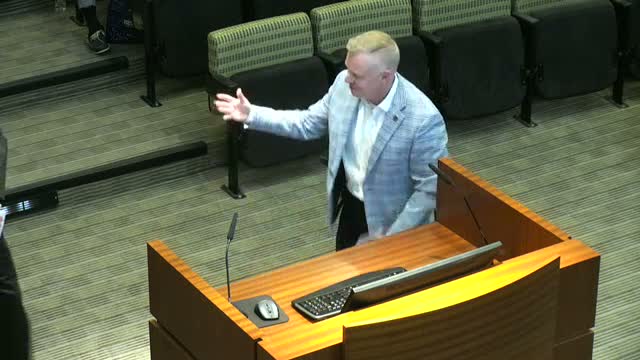
Gary Hendricks, the consultant who prepared Murphy’s last stormwater rate study, told the City Council on May 20 that the city should raise its monthly residential stormwater charge from $3.80 to $4.05 and the nonresidential rate from about $19.13 to $20.66 per acre to fully fund stormwater operation and maintenance.
Hendricks said the review follows Texas Administrative Code guidance and the city’s current practice of funding operation and maintenance (O&M) from a utility fee rather than taxes. “A residence is a residence — every house in Murphy receives the same flat fee,” Hendricks said during the presentation.
The consultant and staff said the proposed increase is intended to close a funding gap. In 2025 the stormwater O&M budget was $521,676 and revenues from the fee did not fully cover those costs; staff provided a revised O&M projection for 2026 of $326,956. Using a five-year, inflation-adjusted average, Hendricks reported an annual O&M requirement of roughly $347,450 and a monthly funding need of $28,954, which produced the recommended per-unit and per-acre rates.
Hendricks described the methodology used to calculate fees: properties inside the city limits were separated into residential (6,024 parcels; about 2,126 developed residential acres) and nonresidential (about 220 acres). He applied typical engineering runoff coefficients (0.5 for residential, 0.9 for commercial) to generate a weighted share of system use and prorated the O&M budget across those shares to set the rates.
The presentation included inventory figures staff said are part of the system Murphy maintains: about 1,456 storm inlets, 107 outfalls, roughly 8,790 feet of box culvert and roughly 55 miles of storm sewer pipe (reported as 291,000 feet).
Hendricks also described an existing credit the city offers nonresidential properties that have functioning detention ponds: the engineering coefficient used for fee calculation is reduced from 0.9 to 0.5 for qualifying sites, which can cut the fee for a large commercial tract by about 44% in his example. He said only a small number of commercial properties in Murphy currently receive the credit — he estimated about three — so the credits do not materially change the overall revenue calculation.
Councilmembers asked how the stormwater fee funds are spent. Hendricks and staff said the money supports activities contained in the city’s stormwater management plan and the annual reporting obligations tied to the city’s municipal separate storm sewer system permit, including routine inspection and maintenance, public education, personnel and equipment, and targeted drainage maintenance projects.
Council members also pressed staff on detention-pond inspections. Hendricks said the city currently performs compliance checks at the time of development approval but does not perform annual reviews of pond maintenance; staff said they were considering an inspection cycle (for example, every three years) and would return with a recommended practice.
No vote or ordinance was taken at the meeting; staff said any proposed rate change would be formalized later in the city’s fee schedule and would take effect Oct. 1 if adopted.
Ending: City staff said they will return to council this summer with fee ordinance language and a proposed effective date as part of the budget/fee schedule process.