Get Full Government Meeting Transcripts, Videos, & Alerts Forever!
Tennessee committee reviews 10 rule changes; Education Freedom Scholarship draws the most scrutiny
Summary
The Joint Government Operations Committee held a rule-review hearing covering 10 rule packages. The Tennessee Education Freedom Scholarship emergency rules prompted extended questioning on eligibility, income verification, virtual school requirements and fraud controls. The House gave a positive recommendation on the EFS rules while the Senate vote
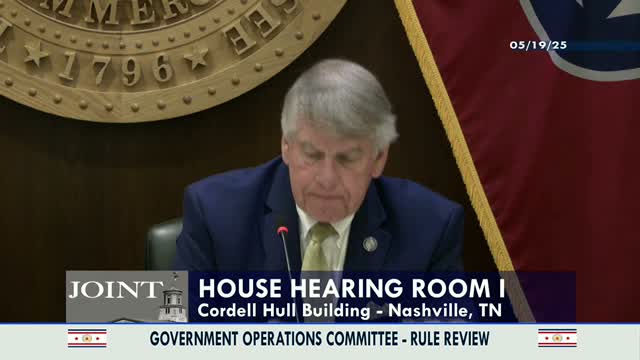
The Joint Government Operations Committee met for a joint Senate-House rule review session where members examined ten rule packages from state boards and agencies, including emergency rules for the new Tennessee Education Freedom Scholarship (EFS) program, multiple State Board of Education rule changes, university tuition classifications and several Department of Finance & Administration and Department of Health proposals.
The most contested item was the State Board of Education's emergency rules to implement the Education Freedom Scholarship program, created by Public Chapter 7 of the First Extraordinary Session of 2025. Nathan James of the State Board of Education told the committee the law requires emergency rules to make the program available in the 2025–26 school year and that the rules focus on definitions, application and eligibility processes, appeals procedures and other logistical matters. "PC 7 states that private schools that enroll EFS recipients retain their autonomy," James said. He added the rules were drafted narrowly to avoid expanding state regulatory authority beyond what the law permits.
Committee members pressed the board and the Department of Education on several operational points. Representative McKenzie asked about the status of applications already submitted; James responded that emergency rules are in effect and the department would address application handling. Representative McKenzie also sought clarification on the statute’s income tiers and whether the program is targeted to low-income families; James said the income allocations are statutory and would require legislative change to alter. Emily Cornute of the Department of Education explained the brick-and-mortar requirement: virtual providers that qualify must maintain a physical presence in Tennessee (a lease or deeded space) where students can receive instruction or assessment.
Representative Fritz asked whether a private school could require employees to apply for a scholarship to receive an employee tuition discount. Rachel Soupey, general counsel for the State Board, said, "I'm not aware of anything in either the statute or the rule that would authorize a private school participating in this program to require that of their employees." The committee also heard that the program requires proof of income (for example, a Form 1040) in many cases but allows alternative documentation such as SNAP or TANF enrollment in some…
Already have an account? Log in
Subscribe to keep reading
Unlock the rest of this article — and every article on Citizen Portal.
- Unlimited articles
- AI-powered breakdowns of topics, speakers, decisions, and budgets
- Instant alerts when your location has a new meeting
- Follow topics and more locations
- 1,000 AI Insights / month, plus AI Chat