Get Full Government Meeting Transcripts, Videos, & Alerts Forever!
Get email alerts on the Education School Choice topic
No spam. Unsubscribe anytime.
Tennessee committee reviews 10 rule changes; Education Freedom Scholarship draws the most scrutiny
Summary
The Joint Government Operations Committee held a rule-review hearing covering 10 rule packages. The Tennessee Education Freedom Scholarship emergency rules prompted extended questioning on eligibility, income verification, virtual school requirements and fraud controls. The House gave a positive recommendation on the EFS rules while the Senate vote
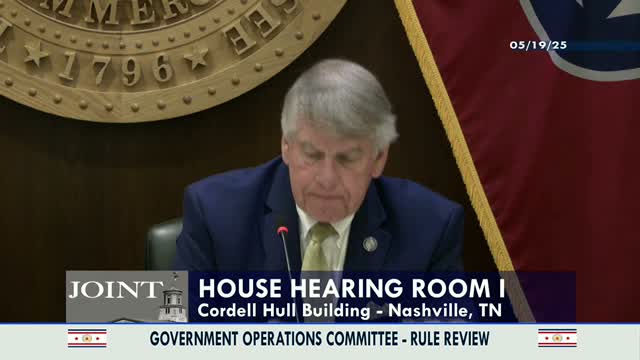
The Joint Government Operations Committee met for a joint Senate-House rule review session where members examined ten rule packages from state boards and agencies, including emergency rules for the new Tennessee Education Freedom Scholarship (EFS) program, multiple State Board of Education rule changes, university tuition classifications and several Department of Finance & Administration and Department of Health proposals.
The most contested item was the State Board of Education's emergency rules to implement the Education Freedom Scholarship program, created by Public Chapter 7 of the First Extraordinary Session of 2025. Nathan James of the State Board of Education told the committee the law requires emergency rules to make the program available in the 2025–26 school year and that the rules focus on definitions, application and eligibility processes, appeals procedures and other logistical matters. "PC 7 states that private schools that enroll EFS recipients retain their autonomy," James said. He added the rules were drafted narrowly to avoid expanding state regulatory authority beyond what the law permits.
Committee members pressed the board and the Department of Education on several operational points. Representative McKenzie asked about the status of applications already submitted; James responded that emergency rules are in effect and the department would address application handling. Representative McKenzie also sought clarification on the statute’s income tiers and whether the program is targeted to low-income families; James said the income allocations are statutory and would require legislative change to alter. Emily Cornute of the Department of Education explained the brick-and-mortar requirement: virtual providers that qualify must maintain a physical presence in Tennessee (a lease or deeded space) where students can receive instruction or assessment.
Representative Fritz asked whether a private school could require employees to apply for a scholarship to receive an employee tuition discount. Rachel Soupey, general counsel for the State Board, said, "I'm not aware of anything in either the statute or the rule that would authorize a private school participating in this program to require that of their employees." The committee also heard that the program requires proof of income (for example, a Form 1040) in many cases but allows alternative documentation such as SNAP or TANF enrollment in some circumstances; the rule packet specifies acceptable documents and authorizes the department to request additional verification when needed.
Several members asked how the program will identify children who move from public to private schools or from private schools already enrolled; the department said the application does not collect a field tracking prior school sector. On allocation and growth of seats, committee members were told the statute establishes a 20,000-seat initial cap, with a statutory growth mechanism that can add up to 5,000 seats in subsequent years subject to appropriation and specific trigger metrics (a threshold tied to application volume). Senator Bolling and others sought numeric clarity about how seats would expand over time; the department explained that students must reapply each year and prioritization rules favor returning recipients when seats are limited.
Committee members also raised fraud, waste and abuse concerns. The department said funds will be disbursed through a digital platform operated by Student First Technologies; tuition payments go directly to schools and any authorized secondary purchases are made through the vendor’s e-wallet platform and are reviewed before funds are released. The rules provide for inquiry and referral on alleged violations: "The department shall conduct an inquiry of any report of fraud or make a referral to the appropriate agency for investigation," the department said in describing the rule language.
Besides EFS, the committee reviewed several State Board of Education rule packages that would broaden approved accreditors for educator preparation programs and adjust licensure pathways. Nathan James told members the educator preparation (including clinical experience requirements) rule will allow nationally recognized accreditors approved by the Council for Higher Education Accreditation and will require mentors to use a TDOE-approved observation tool for clinical practice beginning July 1, 2026. The educator licensure package aligned license validity periods with recent legislation (extending certain professional license validity from up to seven years to up to 11) and allowed the commissioner to issue temporary teaching permits in additional circumstances. Committee members asked repeatedly whether these changes affect substitute teachers; department staff said substitute teachers who are employed under local exceptions may still be in situations not directly changed by these rule revisions, and that statutory definitions and separate statutes also govern substitutes.
The committee also approved a permanent rule update from the University of Tennessee to implement state and federal law that extends in-state tuition classification to certain military spouses and dependents (Public Chapter 1057 of 2024) and to citizens of compact-of-free-association countries (Micronesia, the Marshall Islands, Palau) at in-state rates per federal law.
Other items reviewed and advanced with positive recommendations included: decreased licensing and renewal fees for the Acupuncture Advisory Committee within the Department of Health; updated licensing and training rules for private detection/security services that align with Dallas’s Law and the SAVE Act (including a prohibition on carrying firearms while acting as a security officer unless the guard is properly registered and certified); a TennCare rule creating a supplemental payment methodology for federally qualified health centers and rural health clinics; repeal of an obsolete Department of Finance rule that specified physical printing requirements for annual reports; and permanent rules implementing TennCare coverage for remote fetal monitoring services (remote fetal ultrasound and remote non-stress tests) as required by 2024 legislation.
Quotes and attributions in this report come from committee members and agency representatives who spoke at the hearing: Chairman Jackson; Nathan James, State Board of Education; Emily Cornute, Tennessee Department of Education; Rachel Soupey, State Board general counsel; Amanda Petri and Dan Kilpatrick, TennCare counsel; Shauna Jennings, University of Tennessee associate general counsel; Reid Witcher and Ashton Bodie, Department of Commerce & Insurance; and Livia Johnson and Renoranda French, Department of Health.
Votes at a glance
- Item 1 — State Board of Education: Education Freedom Scholarship (EFS) emergency rules — House: positive recommendation (recorded roll-call totals in the transcript show the House vote prevailed); Senate: the transcript records an earlier Senate roll-call that failed and subsequent procedural votes; committee record shows split action between the chambers (see Actions below). Note: the rule is an emergency rule required so the program may operate in 2025–26; implementation details in the rule packet include application documentation, payment installments, fraud reporting and digital vendor handling of funds.
- Item 2 — State Board of Education: Educator preparation (accreditation/clinical experience) — positive recommendation (Senate and House recorded as passing).
- Item 3 — State Board of Education: Educator licensure (license validity, temporary permits) — positive recommendation (Senate and House recorded as passing).
- Item 4 — State Board of Education: Academic and instructional (promotion and retention; fourth-grade conference pathway) — positive recommendation (Senate and House recorded as passing).
- Item 5 — Department of Health: Acupuncture Advisory Committee fee reductions — motion to pause recommendation carried; the item moved with instructions for the board to consider reserve levels and possible refund policy.
- Item 6 — Department of Commerce & Insurance: Detection Services Licensing Program (private security training, armed guard registration, training standards) — positive recommendation (Senate and House recorded as passing).
- Item 7 — University of Tennessee: In-state tuition classification amendments to implement 2024 state and federal law — positive recommendation (Senate and House recorded as passing).
- Item 8 — TennCare: Supplemental payment rules for RHCs and FQHCs — positive recommendation (Senate and House recorded as passing after committee discussion and a motion to pause that carried in both chambers).
- Item 9 — Department of Finance & Administration: repeal of obsolete printing specifications for annual reports — positive recommendation (Senate and House recorded as passing).
- Item 10 — TennCare: permanent rules to cover remote fetal monitoring (remote fetal ultrasound and remote non-stress testing) — positive recommendation (Senate and House recorded as passing).
Ending
Committee members asked agencies to follow up with additional written clarifications on several operational points raised during the hearing — notably automated application handling for EFS, communications and data-protection practices used during early application-day email problems, precise documentation acceptable for income verification, details about how digital vendor wallets will be audited, and whether the board for acupuncture will consider refund policies when reserves exceed guidance. The committee scheduled no additional action on the record beyond advancing or pausing the packets as noted; several members said they will request follow-up information after the meeting.