Get Full Government Meeting Transcripts, Videos, & Alerts Forever!
Get email alerts on the Education School Choice topic
No spam. Unsubscribe anytime.
Committee reviews emergency rules to implement Tennessee Education Freedom Scholarship; House and Senate split on recommendation
Summary
The joint Government Operations committee examined emergency rules to implement the Tennessee Education Freedom Scholarship (EFS) program created by Public Chapter 7 (First Extraordinary Session, 2025). Staff said the emergency rules are needed to launch the EFS program for the 2025–26 school year; lawmakers raised questions about eligibility, how
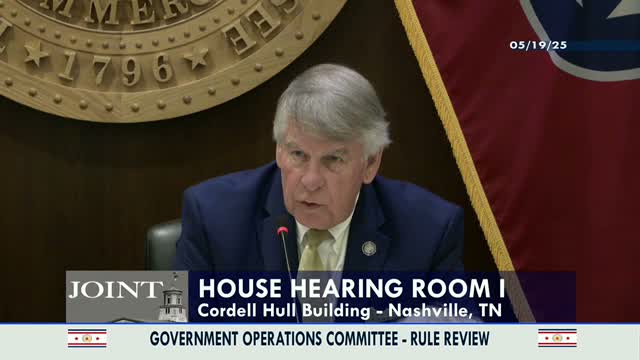
The joint Government Operations committee reviewed emergency rules the State Board of Education and Department of Education filed to implement the Tennessee Education Freedom Scholarship (EFS) program created by Public Chapter 7 of the 2025 first extraordinary session.
The rules, presenters said, define key terms, establish application and eligibility processes and appeals procedures, and address program logistics necessary to make scholarships available for the 2025–26 school year. "PC 7 creates the Education Freedom Scholarship Program and authorizes the State Board of Education to promulgate rules to effectuate the EFS program," Nathan James of the State Board of Education told the committee. He said the statute requires the program be available in the 2025–26 school year and that emergency rules were therefore necessary.
Why it matters: The program will direct state scholarship funds to eligible students who enroll at private schools the rules classify as category 1, 2 or 3. Lawmakers pressed staff on who will be eligible, how funds will flow, and safeguards against fraud and improper use of funds.
What the rules say and how the program will work - Eligibility and timing: The statute sets limits on total years of eligibility (committee discussion referred to "13 years, total eligibility"). The State Board said a permanent version of the rule will be heard on final reading at the board's May 30, 2025 meeting. - School presence: The department told the committee that private virtual programs may qualify only if they have a brick-and-mortar presence in Tennessee—described as a leased or owned space or a location where students can receive instruction or assessment. - Funding tiers and seat caps: Under the law, the initial seat cap is 20,000 students. Committee members discussed how additional seats could be added in later years. The department explained the statute creates a mechanism for incremental expansion tied to utilization and appropriation. - Application and verification: Applications are processed in the order received; department staff told lawmakers the program is first-come, first-served. Income verification may rely on IRS Form 1040 but the rules also allow alternate documentation in some cases (for example, SNAP or TANF enrollment), and the department said it can request additional documents when clarification is needed. - Payments and vendor platform: Payments will be issued through a state-selected vendor and e-wallet platform; the department named Student First Technologies as the e-wallet vendor. Tuition payments are paid directly to schools in installments; department staff said payments are split into four installments to reduce the risk that funds remain at a school after a student leaves. - Program use of residual funds: The rules list authorized secondary uses of excess funds; the department said purchases must be made through the platform and are reviewed before funds are released. - Fraud mitigation and oversight: The rules establish reporting and inquiry procedures; the department said it will investigate allegations and refer suspected criminal fraud to appropriate agencies. The department described an inquiry process and said alleged violations may lead to referrals for enforcement.
Key questions raised by lawmakers - Application processing and early submissions: Representative McKenzie asked whether applications already submitted were being processed; the department replied that the emergency rule is in effect and applications are being handled under that process. - Income targeting and statutory limits: Several lawmakers pressed whether the program's income-targeted set-asides could be changed by rule; staff said the statutory income thresholds are set by the law and can be changed only by the General Assembly. - Food-service requirements: Representatives asked whether private schools accepting EFS students must provide federal school meal programs to qualifying students; the department said nonpublic schools can opt into the Department of Agriculture's school meal programs but are not required to do so. - Employee discounts: Representative Fritz asked whether a private school could require employees to request an EFS scholarship to receive an employee tuition discount. State Board general counsel Rachel Cuppay said she was not aware of statutory or rule authority that would permit a private school to require employees to do that. - Data issues and application confirmation: Representatives reported early problems where some families received incorrect confirmation emails at launch; the department said it corrected the vendor issue by 1 a.m. on launch day and re‑sent correct confirmations.
Committee action and procedural notes Committee members debated a motion for a positive recommendation. The House panel gave the emergency rules a positive recommendation; the Senate roll-call was split and the Senate did not provide an approving recommendation at that time. Committee legal counsel later reviewed committee practice and explained procedural implications of mixed votes by the two chambers.
What comes next The State Board of Education will consider the permanent rule on final reading at its May 30, 2025 meeting; permanent rulemaking will follow the emergency rule if the board proceeds. The department said it will continue outreach to providers and stakeholders and that the program's operational details—such as vendor processes for purchases and fraud referrals—will be carried out during implementation.
Ending note Committee members asked for follow-up information on several operational points, including the vendor confirmation issue and more detail about what the department communicates to families after a suspected data mishap.