Lifetime Citizen Portal Access — AI Briefings, Alerts & Unlimited Follows
Department of Insurance briefs JFAC on PBM compliance, 1332 waiver, wildfire risks and four FY2026 enhancement requests
Loading...
Summary
Director Dean Cameron described Department of Insurance staffing requests and the agency’s oversight work including pharmacy benefit manager reporting under House Bill 596, the state'level 1332 waiver and a proposed homeowner mitigation/reinsurance pool to address wildfire‑driven market stress; lawmakers asked for complaint counts and data on PBMs.
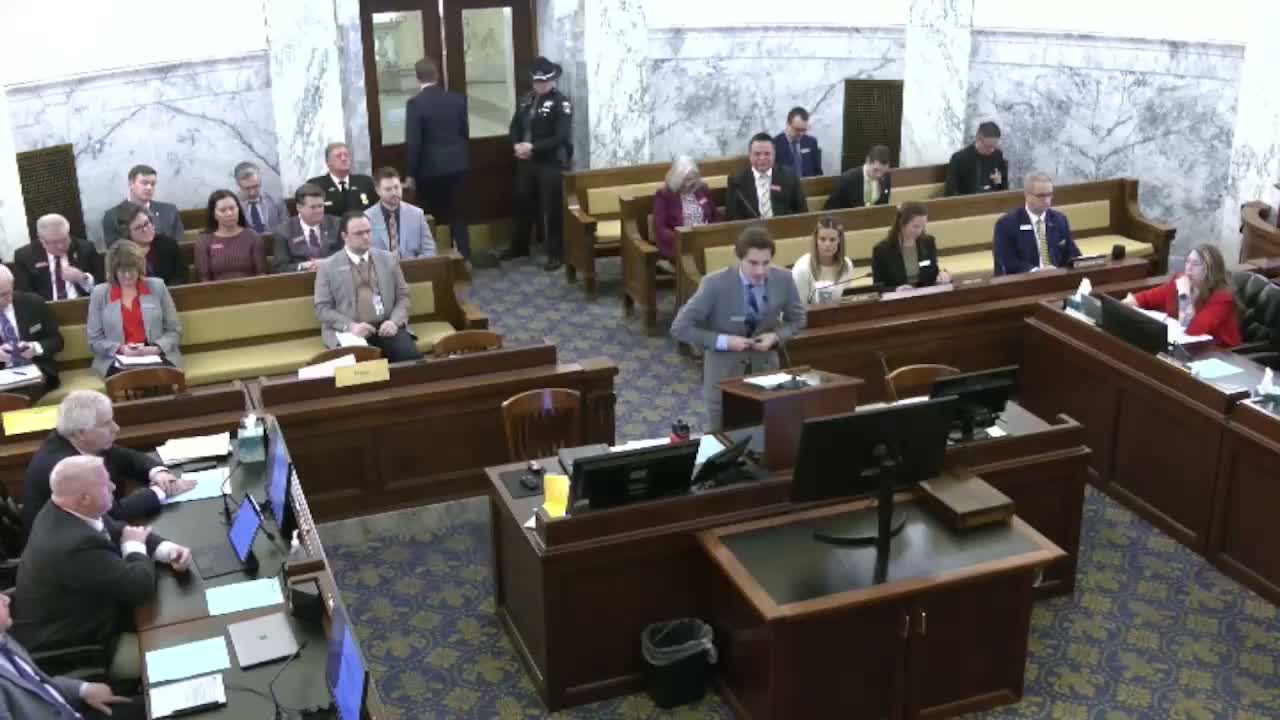
The Joint Finance‑Appropriations Committee on Tuesday reviewed the Idaho Department of Insurance (IDOI) budget and discussed pharmacy benefit manager (PBM) implementation, the state'level 1332 waiver that helped lower individual health insurance rates, and wildfire‑related pressures on the homeowners insurance market.
Noah Peterson of the Legislative Services Office summarized the department’s FY2026 requests, and Director Dean Cameron answered committee questions about PBM oversight, the state’s high‑risk pool and a proposed mitigation/reinsurance pool to address wildfire exposures and shrinking coverage options.
Peterson said the department has 75.5 approved FTPs, split between the Insurance Regulation Division and the State Fire Marshal. The department requested four FY2026 enhancements: one ongoing staff actuary (requested at 95% of policy for salary grade R at $73/hour equivalent, $198,900 ongoing and $3,000 one‑time for equipment), one regulatory compliance specialist (80% of policy for pay grade O at $41.03/hour) to provide internal legal/procedural support and public policy advice, a $48,100 ongoing compensation increase for the state fire marshal chief and deputies ($38,100 salary; $10,000 variable benefits), and $162,200 one‑time capital outlay for replacements including two medium‑duty pickup trucks, cameras and turnout gear.
Director Cameron briefed the committee on PBM reporting that took effect Jan. 1 following passage of House Bill 596 and related amendments to Idaho Code (transcript reference: HB 596; Sec. 41‑349). He said the department hired one staff member to handle PBM work, that “it's a lot more work than what 1 person can do,” and that the agency is receiving numerous complaints and is collecting standardized data submissions from PBMs; most PBMs have complied, he said, while “a few have not.” Cameron said complaints range from unpaid dispensing fees to nonresponsiveness and contractual disputes and that the agency will provide a fuller report as data collection continues.
Cameron also described Idaho’s use of a 1332 waiver and a state high‑risk reinsurance pool, which he said helped lower individual market rates and increase carrier participation on the exchange. “We instituted that three years ago…and since then we've had a reduction in individual health insurance rates each year,” he told the committee. He described how the high‑risk pool functions as reinsurance by reimbursing a share of claims for defined high‑cost conditions and spreading risk so carriers can offer coverage at lower rates.
On property insurance, Cameron warned that wildfire and other catastrophes plus inflation and reinsurance cost increases are tightening the market. He said some insurers have reduced writing in fire‑prone areas or nonrenewed policies in parts of Idaho, and noted insolvency activity among carriers in the prior year. To address market stress, Cameron described proposed legislation to create a pool that would serve two functions: (1) fund homeowner mitigation (for example, replacing eave mesh, removing combustible vegetation) to harden structures against fire risk, and (2) act as a mechanism to help carriers remain in the Idaho admitted market. He said the surplus lines market has more than doubled in volume and that surplus lines policies generally offer fewer consumer protections.
Representative Furness and Senator Cook asked Cameron for detail on the 1332 waiver and the high‑risk pool outcomes; Cameron said the pool has helped keep age‑to‑age rates lower and doubled carrier participation on the exchange since its expansion. Representative Furness asked for a brief explanation of the high‑risk pool mechanism; Cameron said it functions like reinsurance tied to CPT codes for expensive conditions.
The committee also noted department performance measures, including a 100% response time metric for arson calls; Cameron said department staff were on the ground during last year’s wildfires to assist consumers and coordinate with insurers. He said Idaho experienced just under one million burned acres that year and that over 140 structures were lost, including about 40 residences, underscoring the need for mitigation efforts.
Cameron introduced senior staff attending the hearing, including Deputy Director Wes Trucksler, Public Information Officer Julie Robinson, fiscal officer Lisa McIntosh and others. He said the department has largely filled its positions and thanked the committee for past budget support.
No formal committee vote was taken during the presentation.