Get Full Government Meeting Transcripts, Videos, & Alerts Forever!
Get email alerts on the Planning Programs topic
No spam. Unsubscribe anytime.
Planning staff presents Part 3 of General Plan annual progress report covering open space, air quality and safety
Summary
Planning staff summarized Part 3 of the 2023–2024 General Plan Annual Progress Report, highlighting preliminary and environmental review processes, interagency collaboration (CVAG, SCAG, fire department), GIS mapping (GeoHub), and recent projects used as examples, such as the Wren and Grove Street Apartments.
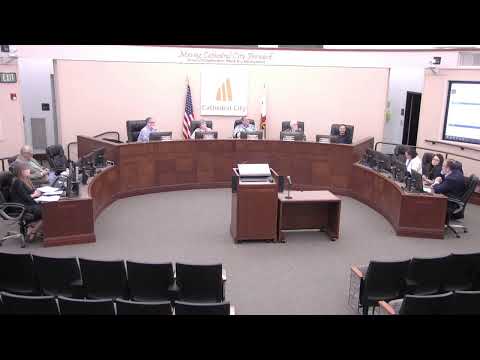
City planning staff presented Part 3 of the 2023–2024 General Plan Annual Progress Report at the Feb. 5 meeting, providing an update on implementation of the open space and conservation, air quality and climate stability, and safety elements of Cathedral City’s general plan.
Dom Camps, associate planner, told the commission the part-3 presentation focuses on four themes: the preliminary review process (used more frequently to provide early design feedback), environmental review (when a project requires an initial study or EIR versus when it qualifies for exemptions), interagency collaboration (for example with the Coachella Valley Association of Governments and the South Coast Air Quality Management District), and use of GIS mapping (the City’s GeoHub) to inform decisions on habitat, hazard zones and truck routes.
Camps cited recent or ongoing projects as examples of how staff applies policies: the Ramon Road commercial preliminary review (where staff recommended rotating a drive-through away from nearby residences to reduce noise), the Wren project (a proposed 204-unit multifamily development that required an initial study and multiple technical studies), and the Grove Street Apartments (a 19-unit, 0.6-acre infill project that qualified for a CEQA Class 32 infill exemption). He said the preliminary review process lets planning, building, engineering, fire and police provide early, high-level feedback to reduce later conflicts and environmental impacts.
On interagency work, staff described cooperation with CVAG on regional transportation and the regional climate action plan, with the fire department leading updates to the local hazard mitigation plan and emergency operations plan and with regular outreach to schools and community groups on emergency preparedness. The presentation emphasized GeoHub’s role in showing FEMA flood zones, fault zones, zoning maps, master roadway classifications and fire and flood hazard zones to support planning and safety decisions.
Commissioners asked about the remaining CV Link construction in Cathedral City, how to track overdue general plan programs and the influence of Measure W revenues. Staff said Cathedral City’s CV Link work is nearing completion within city limits, the APR is a baseline tool that will be updated annually to show progress on overdue or ongoing programs, and that Measure W will indirectly affect city services and capital projects—Measure W funds were earmarked for park maintenance and a residential street paving allocation in the CIP.
Why it matters: the annual progress report documents how key general plan policies are being implemented, identifies where additional environmental or technical review is required, and shows how city staff and regional partners coordinate on climate, safety and conservation issues.